
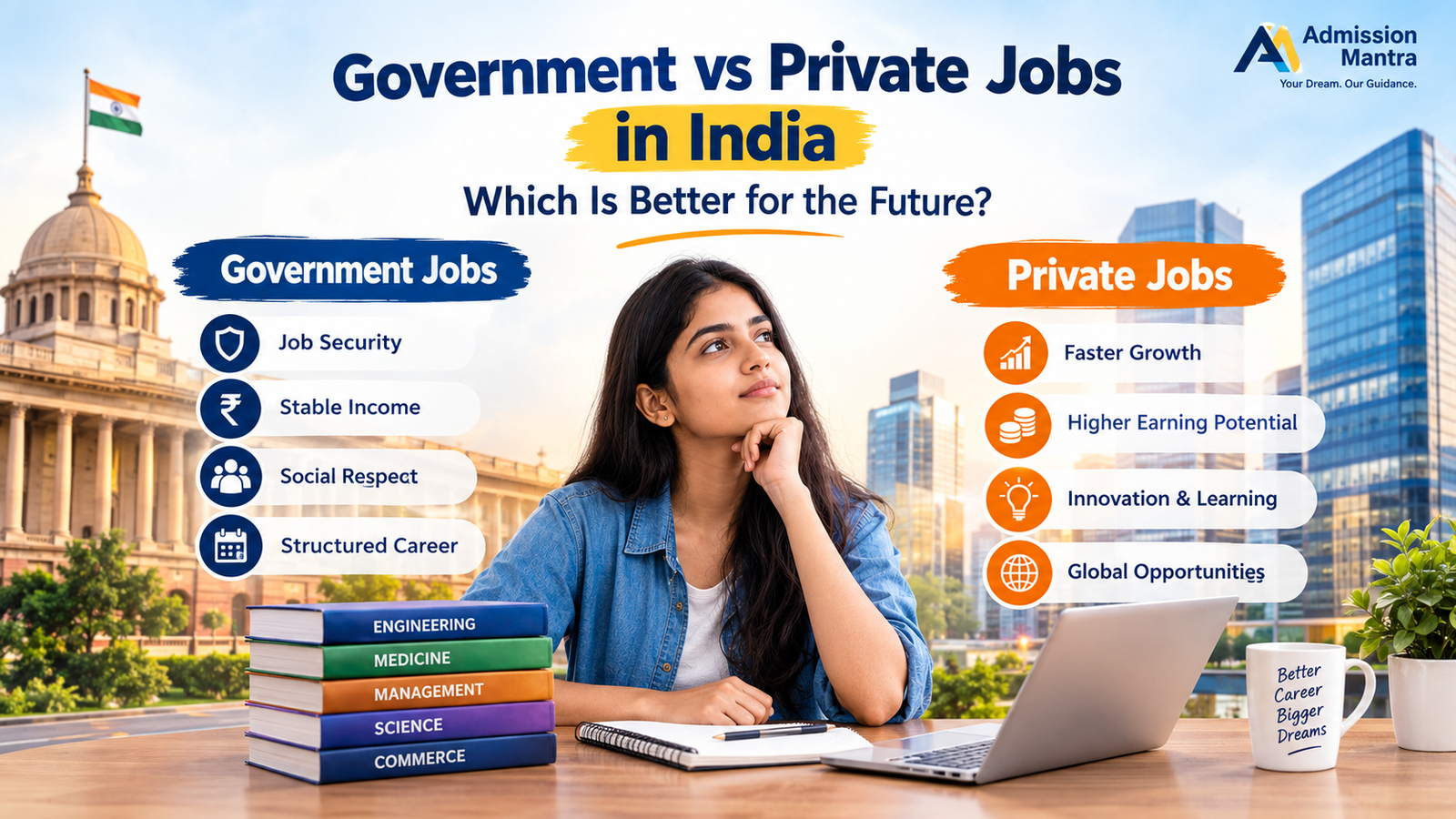
Government Jobs vs Private Jobs in India: Which Is Better for the Future?
Government jobs vs private jobs is one of the most common career questions asked by Indian students and parents.
For decades, a government job was widely associated with stability, predictable service conditions and social respect. Meanwhile, private-sector careers were often associated with faster growth, competition, changing roles and higher variation in income.
However, the Indian employment landscape is changing.
Technology, artificial intelligence, digitalisation, startups, global companies, specialised skills and new forms of work are changing what employers expect from graduates.
At the same time, government departments are also adopting digital systems, technology-enabled services and new administrative processes.
So, which path should a student choose?
The better question is not simply:
“Government job or private job?”
Instead, ask:
“Which career path matches my skills, interests, financial goals, preferred work environment and long-term plans?”
This article explains the differences between government and private jobs in India in simple language, so students and parents can make a more informed career decision.
Government Jobs vs Private Jobs: Quick Comparison
Before going into detail, here is a simple overview.
| Factor | Government Jobs | Private Jobs |
|---|---|---|
| Job structure | Usually highly structured | Varies by organisation |
| Employment security | Often stronger service protections after appointment | More dependent on company, role and business conditions |
| Salary structure | Usually based on defined pay structures and allowances | Varies significantly by employer and role |
| Salary growth | Often linked to pay revisions, increments and promotions | Can vary through increments, promotions, bonuses, incentives and job changes |
| Recruitment | Competitive exams and selection processes are common | Applications, interviews, tests, referrals and campus hiring are common |
| Work environment | Usually process-driven | Often organisation- and role-specific |
| Transfers | Possible in many government roles | Depends on company and role |
| Innovation | Varies by department and role | Often stronger in technology and growth-oriented sectors |
| International exposure | Depends strongly on service and posting | More common in multinational and globally connected roles |
| Remote work | Limited in many roles, depending on department | More common in some industries |
| Career flexibility | Depends on service rules | Can be broader in some industries |
| Skill development | Can depend on department and role | Often closely linked to industry requirements |
This table gives only a broad picture.
The actual experience can differ significantly between two government departments or two private companies.
Why Are Government Jobs Still Popular in India?
Government jobs continue to attract students for several reasons.
First, government employment generally comes with clearly defined service rules, pay structures, leave provisions and promotion systems. For many families, that structure creates a sense of long-term stability.
Second, some government careers provide significant responsibility in areas such as administration, public services, engineering, taxation, education, healthcare, policing, defence and regulation.
Third, competitive recruitment examinations create a well-defined entry route for many positions.
The Union Public Service Commission (UPSC) conducts examinations for appointment to services of the Union and also carries out recruitment through selection processes. Read the official UPSC functions.
Similarly, the Staff Selection Commission (SSC) conducts recruitment examinations for various roles across government departments and organisations. Its official website lists examinations such as Junior Engineer, Combined Higher Secondary Level and Constable GD. Explore the official SSC examination portal.
Therefore, students interested in government employment should understand that the pathway is usually structured but competitive.
Government Jobs: Major Advantages
1. Structured Employment Conditions
One of the biggest attractions is the presence of defined service rules.
Depending on the post and department, employees may have clearly specified:
- Pay structure
- Leave rules
- Allowances
- Promotion frameworks
- Working conditions
- Retirement provisions
This structure can be particularly attractive to people who prefer predictability.
2. Retirement Benefits Depend on the Service and Applicable Scheme
It is important to update an old assumption here.
Not every government employee simply receives the same traditional pension.
For Central Government employees covered by the National Pension System, the Unified Pension Scheme (UPS) was introduced as an option effective from 1 April 2025, subject to the applicable rules and eligibility conditions. The Department of Financial Services provides the current official UPS rules and FAQs. See the official Unified Pension Scheme information.
Therefore, students and parents should check the exact retirement and pension framework applicable to the specific government post.
This is more accurate than simply assuming:
“Every government job has the old pension system.”
3. Long-Term Stability Can Be Important
Government employment can provide a different risk profile compared with many private-sector roles.
After appointment, service is generally governed by formal rules and procedures. However, that does not mean every government job is stress-free or that employment can never end.
Transfers, disciplinary procedures, workload, departmental requirements and administrative responsibilities can all affect the employee’s experience.
Consequently, students should think about stability as one factor, not the entire career decision.
4. Public-Service Career Opportunities
Government employment can appeal to students who want to work in areas connected to:
- Public administration
- Education
- Healthcare
- Infrastructure
- Defence
- Public finance
- Regulation
- Law enforcement
- Rural development
- Social programmes
- Engineering and technical services
For some students, the opportunity to work on public-facing systems and services can be an important career motivation.
5. Social Recognition
Government positions continue to carry social recognition in many parts of India.
Parents may see such jobs as symbols of stability and respect.
However, students should remember that social reputation should not be the only reason to choose a profession.
A career should also match:
- Interest
- Aptitude
- Skills
- Work preferences
- Financial goals
- Long-term plans
Government Jobs: Limitations Students Should Consider
1. Competitive Recruitment
Government recruitment can involve highly competitive examinations.
The UPSC and SSC websites list numerous examinations and recruitment processes covering different services and posts. Therefore, students need to understand the specific eligibility criteria, syllabus, selection stages and competition associated with the examination they target.
Preparation can also take significant time.
For some students, spending several years preparing for one examination may be appropriate. For others, beginning a degree and simultaneously building employable skills may provide a different career route.
2. Career Progression Is Usually More Structured
Government promotions generally operate within established service rules and departmental structures.
As a result, career progression may not work in exactly the same way as in a private company where performance, business growth, role changes and external job offers can influence advancement.
That structure can be a benefit for people who prefer predictability.
At the same time, students who strongly prefer rapid role changes or entrepreneurial environments may find the private sector more compatible.
3. Transfers Can Matter
Some government careers involve transfers or postings.
This can affect:
- Family arrangements
- Schooling
- Housing
- Travel
- Lifestyle
Therefore, applicants should research the specific service rather than assuming that every government post has the same transfer policy.
4. Innovation Depends on the Department
Government organisations are increasingly using digital technology.
Nevertheless, the degree of innovation can vary widely between departments, roles and levels of administration.
A student interested in cutting-edge product development, startups or rapidly changing technology may therefore want to compare the actual role rather than simply selecting “government” as a category.
Why Are Private Jobs Becoming More Attractive?
India’s private sector covers a very wide range of employment.
It includes:
- IT
- Software
- Banking
- Finance
- Healthcare
- Pharmaceuticals
- Manufacturing
- Consulting
- E-commerce
- Retail
- Media
- Education
- Logistics
- Startups
- Artificial Intelligence
- Cybersecurity
- Data
- Semiconductors
- Renewable energy
India’s Economic Survey 2025–26 describes services as a major driver of India’s growth, exports and employment, with the sector contributing more than half of Gross Value Added. It also highlights the continued expansion of digitally and remotely deliverable services. Read the official Economic Survey 2025–26.
That broader services ecosystem creates many types of career opportunities, although opportunities vary greatly by industry, company and individual skill level.
Private Jobs: Major Advantages
1. Wider Range of Career Paths
A major advantage of the private sector is variety.
A graduate can potentially work in roles such as:
- Software development
- Data analysis
- Product management
- Marketing
- Finance
- Human resources
- Sales
- Design
- Consulting
- Operations
- Cybersecurity
- Research
- Healthcare technology
This variety allows students to explore different career directions.
2. Faster Role Changes Can Be Possible
Private organisations may create new roles as their businesses expand.
Consequently, employees can sometimes move from:
Trainee → Executive → Senior Executive → Manager → Specialist → Leadership
However, the exact path depends entirely on the company and employee.
Some organisations promote quickly.
Others have slower structures.
Therefore, students should avoid assuming that every private company offers rapid growth.
3. Performance Can Influence Compensation
Private-sector compensation can include:
- Base salary
- Annual increments
- Performance bonuses
- Sales incentives
- Stock or equity in some organisations
- Joining bonuses
- Retention benefits
The exact package varies significantly.
For example, an entry-level role in a startup can have a very different compensation structure from a role in a large multinational corporation.
4. International Exposure Can Be More Common in Some Industries
Students working for multinational companies may get exposure to:
- International clients
- Global teams
- Cross-border projects
- International technologies
- Overseas offices
- Remote collaboration
However, this is not guaranteed.
It depends on the company, department and role.
Private Jobs: Limitations Students Should Understand
1. Employment Can Be More Sensitive to Business Conditions
Private companies operate according to business conditions.
Therefore, hiring can rise or fall depending on:
- Revenue
- Investment
- Industry demand
- Economic conditions
- Technology changes
- Company strategy
- Business restructuring
That can create more employment uncertainty in some roles.
However, not every private industry has the same level of volatility.
2. Performance Expectations Can Be High
Private organisations may use:
- Targets
- Deadlines
- Performance reviews
- Sales goals
- Productivity metrics
- Customer satisfaction measures
For some students, these environments can be motivating.
For others, a slower-paced or more structured environment may be more comfortable.
The right choice therefore depends on the individual.
3. Work-Life Balance Varies Widely
The statement “government jobs are relaxed and private jobs are stressful” is too simplistic.
A government officer may have demanding responsibilities, public-facing work, deadlines or transfers.
Similarly, some private companies offer flexible working arrangements, hybrid work, leave policies and supportive workplace cultures.
Therefore, work-life balance depends on:
Role + Organisation + Manager + Industry + Workload + Location
rather than the sector alone.
Government Jobs vs Private Jobs: Salary Comparison
Salary is one of the first questions parents ask.
However, a simple “government salary vs private salary” comparison can be misleading.
Government Sector
Compensation is generally linked to the applicable pay structure, grade, allowances and service rules.
Predictability can therefore be higher.
Private Sector
Compensation varies much more widely according to:
- Skill
- Industry
- Company
- Experience
- Location
- Role
- Performance
- Negotiation
- Demand for the skill
As a result, some private-sector careers may have much higher compensation potential, while other private jobs may not.
Likewise, government compensation can vary significantly by service and level.
The Better Comparison
Instead of asking only:
“Who earns more?”
compare:
Starting salary + growth + benefits + work conditions + retirement provisions + career flexibility + personal goals
That gives a more realistic picture.
Government Jobs vs Private Jobs: Work-Life Balance
Work-life balance is often treated as a simple sector comparison.
It is not.
Government Work-Life Balance Can Depend On
- Department
- Posting
- Role
- Public-facing responsibility
- Transfer requirements
- Emergency duties
- Workload
Private Work-Life Balance Can Depend On
- Company culture
- Manager
- Industry
- Project deadlines
- Customer-facing work
- Shift pattern
- Remote or hybrid policy
Therefore, two jobs in the same sector can have completely different working experiences.
Before accepting an offer, students should investigate the specific role and employer.
Government Jobs vs Private Jobs: Skills Required
One thing is becoming increasingly clear across both sectors:
Students need relevant skills.
The World Economic Forum’s Future of Jobs Report 2025 says employers expect 39% of workers’ existing skill sets to be transformed or become outdated between 2025 and 2030. It also identifies AI and big data, networks and cybersecurity, and technological literacy among the fastest-growing skills, alongside human capabilities such as analytical thinking, creative thinking, resilience, flexibility and leadership.
The OECD’s June 2026 report A Skills-First Labour Market similarly describes a widening gap between changing employer needs and what formal education alone can provide.
Therefore, students should not prepare only for a job title.
They should build capabilities.
Admission Mantra’s Skill-Based Degrees vs Traditional Degrees in India 2026 explains why combining formal education with practical skills can be useful.
Which Skills Can Help in Both Government and Private Careers?
Certain skills are useful across sectors.
1. Communication
Students should learn how to:
- Write clearly
- Speak confidently
- Present ideas
- Explain information
- Participate in discussions
2. Digital Literacy
Depending on the career, students may benefit from:
- Office tools
- Data analysis
- AI tools
- Research tools
- Digital communication
- Coding
- Industry software
3. Problem-Solving
Good professionals should be able to understand a problem, examine available information and develop a practical solution.
4. Analytical Thinking
Analytical skills can help with:
- Data
- Policy
- Finance
- Engineering
- Research
- Business decisions
5. Adaptability
Technology and job requirements change.
Therefore, the ability to learn new skills can become a long-term career advantage.
Admission Mantra also discusses these issues in Marks vs Skills in Education 2026: What Parents Should Know.
Government vs Private Jobs in the Age of AI
Artificial Intelligence is changing both sectors.
The effect, however, will not be identical across occupations.
Government Sector
AI and digital systems can increasingly support:
- Data processing
- Citizen services
- Document management
- Administrative workflows
- Analysis
- Monitoring
- Digital governance
Private Sector
AI is affecting:
- Software development
- Marketing
- Finance
- Customer service
- Data analysis
- Design
- Manufacturing
- Healthcare technology
- Business operations
The important lesson is that AI is more likely to change tasks and job requirements than to make every career disappear overnight.
The WEF’s 2025 research expects technology to drive both job creation and job displacement through 2030, while also emphasising the need for reskilling and upskilling.
Students can also read Admission Mantra’s Careers in India Less Likely to Be Replaced by AI: 2026 Guide for a broader discussion of career resilience and human skills.
Government Jobs vs Private Jobs: Which Has Better Future Scope?
There is no single sector that has better future scope for every student.
Instead, future scope depends on the specific career.
For example:
Government Career Path
A student may prefer government employment if they are interested in:
- Public administration
- Defence
- Public engineering
- Government healthcare
- Education
- Regulation
- Public finance
- Civil services
Private Career Path
Another student may prefer:
- Software
- AI
- Data
- Cybersecurity
- Finance
- Consulting
- Marketing
- Product management
- Design
- Startups
- Entrepreneurship
Hybrid Career Planning
There is also a third approach.
A student can prepare for a government examination while developing employable private-sector skills.
For example:
B.Com + Government Exam Preparation + Excel + Financial Skills
or:
B.Tech + Government Technical Exams + Coding + Industry Internship
This approach can provide more than one possible career route.
However, students should manage preparation time carefully rather than trying to pursue too many options without a clear plan.
Should Students Prepare for a Government Exam After 12th?
That depends on the examination and the student’s eligibility.
Some government recruitment pathways are available after Class 12, while others require a bachelor’s degree or another qualification.
Therefore, students should first identify the exact government role they want.
Then check:
- Minimum qualification
- Age limit
- Subjects
- Examination stages
- Physical requirements where applicable
- Syllabus
- Recruitment calendar
The official UPSC and SSC websites should be used for current notifications rather than relying only on coaching advertisements.
For students still deciding what to study after Class 12, Admission Mantra’s Best Courses After 12th in India: Career Options, Fees & Scope explains how to choose a course based on career goals, interests, budget and future opportunities.
What Degree Should You Choose for Government Jobs?
There is no universal degree that guarantees a government job.
Different examinations and posts have different eligibility requirements.
Depending on the target career, students may choose:
- Arts
- Commerce
- Science
- Engineering
- Law
- Management
- Medicine
- Agriculture
- Other specialised fields
The correct approach is to work backwards.
Start With the Target Job
For example:
Target career → Eligibility → Required qualification → Suitable degree → Exam preparation
That is often more useful than choosing a degree first and trying to find a job later.
What Degree Should You Choose for Private Jobs?
Private-sector careers are even more varied.
A technology company may need:
- Engineers
- Developers
- Data professionals
- Designers
- Finance professionals
- Product managers
- HR professionals
- Sales professionals
A hospital may need:
- Doctors
- Nurses
- Pharmacists
- Administrators
- Finance teams
- IT professionals
- HR staff
A finance company may need:
- Accountants
- Analysts
- Sales professionals
- Risk specialists
- Technology teams
Therefore, students should select the degree based on the career they want to build, not simply the sector they want to join.
Which Is Better for Students After Class 12?
The government-versus-private decision should not be the first decision.
A better sequence is:
Step 1: Understand Your Strengths
Ask:
- Which subjects do I enjoy?
- Do I prefer structured work?
- Do I enjoy technology?
- Do I like dealing with people?
- Do I prefer analysis?
- Do I enjoy leadership?
- Do I like public-service work?
Step 2: Explore Career Options
Students can compare different routes through Admission Mantra’s Best Courses After 12th in India.
Step 3: Select the Right Course
Choose a qualification that supports your intended career.
Step 4: Build Relevant Skills
Do not wait until the final year.
Start developing practical skills during college.
Step 5: Gain Experience
Internships, projects, competitions and research can improve your understanding of the field.
Step 6: Keep More Than One Door Open
Where appropriate, students can prepare for both government examinations and private-sector opportunities.
Government Jobs vs Private Jobs: A Practical Decision Framework
Parents and students can use this simple framework.
| Question | Government May Suit You If… | Private May Suit You If… |
|---|---|---|
| Stability | You strongly value structured service conditions | You are comfortable with greater variation |
| Growth | You prefer predictable progression | You want potentially faster role changes |
| Work style | You prefer established systems | You enjoy dynamic environments |
| Competition | You are comfortable with exam preparation | You prefer interview and skill-based hiring |
| Innovation | You prefer public systems or administration | You enjoy technology, products or business |
| Location | You are comfortable with possible postings | You want more control depending on employer |
| International exposure | Your target government role provides it | You want multinational exposure |
| Risk | You prefer lower employment uncertainty after appointment | You accept more variation for wider opportunities |
| Skills | You are ready to prepare for the target exam and role | You are ready for continuous industry learning |
| Entrepreneurship | Less directly aligned with most conventional roles | More directly available through startups and business |
This is not a ranking.
Instead, it is a way to identify which environment may fit your preferences.
What Parents Often Get Wrong
Many parents tell children:
“Government job means a secure life.”
That statement contains only part of the picture.
Government careers can offer structured employment conditions, but students still need the right qualification, preparation and professional skills.
Similarly, saying:
“Private job means high salary.”
is also too broad.
Private-sector salaries can vary dramatically.
A graduate may receive a modest salary in one company and a much higher package in another. Industry, skill level, location, role and company performance all matter.
Therefore, parents should focus less on labels and more on fit.
Don’t Choose a Career Only Because of Social Pressure
Career choices can become difficult when students hear:
- “Government jobs are safer.”
- “Everyone should do engineering.”
- “Private jobs have no security.”
- “Only MBA gives growth.”
- “Only government officers get respect.”
- “Software jobs are the future.”
- “This course guarantees a high salary.”
Such statements oversimplify a complex employment market.
Instead, examine:
Interest + Aptitude + Qualification + Skills + Career Demand + Financial Reality
That gives the student a more realistic foundation.
Government Jobs vs Private Jobs: What About Entrepreneurship?
There is another important distinction.
A private-sector career can also lead to entrepreneurship.
Students may gain experience in:
- Startups
- Sales
- Product development
- Marketing
- Finance
- Operations
- Technology
Later, some professionals may use that experience to build their own businesses.
Government employment usually follows a different career structure because employees operate under public service rules and responsibilities.
Therefore, students with a strong entrepreneurial interest should consider whether a private-sector or business pathway better matches their long-term goals.
What Happens If the Private Job Ends?
This is a common concern among students and parents.
A private job ending does not necessarily mean the end of a career.
A professional with strong skills may be able to:
- Change companies
- Move to another industry
- Learn a new technology
- Take freelance work where appropriate
- Pursue higher education
- Build a business
- Move into consulting
- Explore other roles
This is why employability should be viewed as more than one job.
Job security and career security are not exactly the same thing.
A person may lose one job but still have strong career prospects because their skills remain valuable.
That is why students should continuously build their capabilities.
What Happens If a Government Exam Doesn’t Work Out?
Government exam preparation can be valuable, but students should also have a backup plan.
For example:
Graduation + Exam Preparation + Employable Skill
is generally a more flexible strategy than:
Exam Preparation Without a Career Backup
Students can develop:
- Communication
- Excel
- Data analysis
- Coding
- Accounting
- Teaching
- Research
- Writing
- Digital marketing
- Industry-specific skills
The right backup depends on the student’s degree and interests.
Consequently, a failed attempt at one examination does not have to become a failed career.
Government vs Private Jobs: The Future Is Skills-Driven
One of the strongest conclusions from current labour-market research is that students will need to keep learning.
The WEF estimates that 39% of workers’ existing skill sets are expected to be transformed or become outdated between 2025 and 2030. It also reports that analytical thinking remains a leading core skill, while AI and big data, cybersecurity and technological literacy are among the fastest-growing areas.
The OECD’s 2026 report similarly highlights the changing relationship between formal qualifications and employer skill requirements.
Therefore, the most important long-term question may not be:
Government or private?
It may be:
“Can I continue learning as the job market changes?”
That ability can help in either sector.
A Better Way to Think About Career Success
Career success is not determined by employer type alone.
A more useful model is:
Career Success = Qualification + Skills + Experience + Adaptability + Opportunity
Qualification
Gives you eligibility for specific careers.
Skills
Help you perform the work.
Experience
Shows that you can apply what you have learned.
Adaptability
Helps you remain relevant when technology and industries change.
Opportunity
Depends on the market, employer, competition, location and timing.
This model applies to both government and private careers.
What Should Students Do in College?
Students can use their college years to create more than a degree certificate.
First Year
Build:
- Academic fundamentals
- Communication
- Digital literacy
- Career awareness
Second Year
Add:
- Projects
- Technical skills
- Competitions
- Career-specific learning
Third Year
Focus on:
- Internships
- Research
- Professional networking
- Exam preparation if required
Final Year
Prepare for:
- Placements
- Government exams
- Higher studies
- Interviews
- Major projects
- Career-specific certifications
The exact timeline depends on the degree.
Still, the principle is simple:
Use college to build career readiness, not just classroom marks.
Frequently Asked Questions
Are government jobs better than private jobs?
There is no universal answer. Government and private careers have different structures, expectations, compensation models and working environments. The better fit depends on the student’s priorities, skills, career goals and risk preferences.
Which gives a higher salary: government or private jobs?
There is no single answer. Government compensation is generally linked to defined pay structures and service rules, while private compensation varies widely by company, industry, role, skill and experience.
Which has better job security?
Government employment can offer stronger formal service protections after appointment in many roles. Private-sector employment can be more sensitive to company performance and market conditions. However, security also depends on the specific job and organisation.
Are private jobs risky in 2026?
Some private roles can experience greater employment volatility than government positions. At the same time, demand remains strong in several technology, services, healthcare, finance and specialist areas. The individual’s skills and industry also matter.
Can government employees work from home?
This depends on the department, role and applicable administrative rules. Students should not assume that all government jobs offer remote work.
Do all government jobs have pensions?
No. Retirement benefits depend on the applicable service, pension scheme and eligibility. For example, the Unified Pension Scheme is an option under NPS for eligible Central Government employees from 1 April 2025 under the applicable rules. Check the official UPS information.
Is private-sector growth always faster?
Not necessarily. Some private-sector roles can offer rapid progression, but growth depends on the company, industry, employee performance and available opportunities.
Should students prepare only for government examinations?
Not necessarily. Students may consider maintaining a broader career plan, especially if their government-exam target is highly competitive.
Can an engineering student prepare for government jobs?
Yes, depending on the examination and eligibility requirements. Students can also keep private-sector engineering opportunities open by developing technical skills, projects and internships. For Karnataka students, Admission Mantra’s Engineering Admissions in Karnataka: College, Branch & Counselling Guide explains how college, branch and career goals can be evaluated together.
Can management students work in government as well as private organisations?
Yes. Management graduates can explore private-sector roles as well as government and public-sector opportunities, depending on eligibility and recruitment requirements. Students interested in BBA and MBA pathways can read Management Admissions: BBA, MBA & Business School Selection Guide.
Final Takeaway: Government vs Private Jobs Is a Personal Career Decision
The debate around government jobs vs private jobs is unlikely to disappear.
For many families, government employment will continue to represent stability, structured service conditions and public-service opportunities.
Meanwhile, the private sector will continue to offer a wide range of careers across technology, finance, healthcare, manufacturing, services, startups and other industries.
Neither path is automatically better for every student.
The right choice depends on:
Interest
Aptitude
Qualification
Skills
Career goals
Financial expectations
Preferred work environment
Tolerance for uncertainty
Long-term plans
If a student prefers structured service conditions and is comfortable with competitive examination preparation, a government career may be worth exploring.
If another student enjoys technology, innovation, dynamic organisations or faster role changes, a private-sector career may be more suitable.
However, there is an important common factor:
Skills remain valuable in both sectors.
The World Economic Forum’s Future of Jobs Report 2025 shows that employers expect significant changes in skills through 2030, with technology skills rising alongside analytical thinking, creativity, resilience, flexibility and lifelong learning.
Similarly, the OECD’s 2026 research highlights the growing importance of connecting formal education with the skills employers actually need.
Therefore, students should not build their entire future around one job title.
Build a qualification.
Develop useful skills.
Gain practical experience.
Understand your industry.
Keep learning.
Then choose the career path that fits your goals.
In the end, the most useful question is not:
“Government or private?”
It is:
“Which career path can help me build a stable, meaningful and sustainable professional future?”
That is the decision students should make based on their own strengths, interests, goals and informed understanding of the options.
Related Admission Mantra Guides
Students planning their careers after Class 12 can also explore these Admission Mantra resources:
Best Courses After 12th in India: Career Options, Fees & Scope
Skill-Based Degrees vs Traditional Degrees in India 2026
Marks vs Skills in Education 2026: What Parents Should Know
Careers in India Less Likely to Be Replaced by AI: 2026 Guide
Top Courses in Demand in India 2026
How to Choose the Right College After 12th in India: 2027 Guide
Best Engineering Courses in India: BTech or BE Scope 2027–2030
Engineering Admissions in Karnataka: College, Branch & Counselling Guide
Management Admissions: BBA, MBA & Business School Selection Guide
What to Do After 12th Without NEET & JEE in 2026
Trusted Official Sources
Students should always check current recruitment notifications directly from official authorities.
Government Recruitment
Union Public Service Commission (UPSC)
Staff Selection Commission (SSC)
Retirement and Pension Information
Department of Financial Services — Unified Pension Scheme
India Employment and Economic Context
Government of India — Economic Survey 2025–26
Future Skills and Employment Trends
World Economic Forum — Future of Jobs Report 2025
OECD — A Skills-First Labour Market, 2026
Important Disclaimer
Government recruitment rules, eligibility criteria, examination schedules, pay structures, pension provisions and private-sector employment conditions can change.
Therefore, students and parents should verify the latest information through the relevant government department, official examination authority, employer or regulatory body before making an education or career decision.
Admission Mantra provides educational, admission and career guidance to help students and parents make informed decisions.