
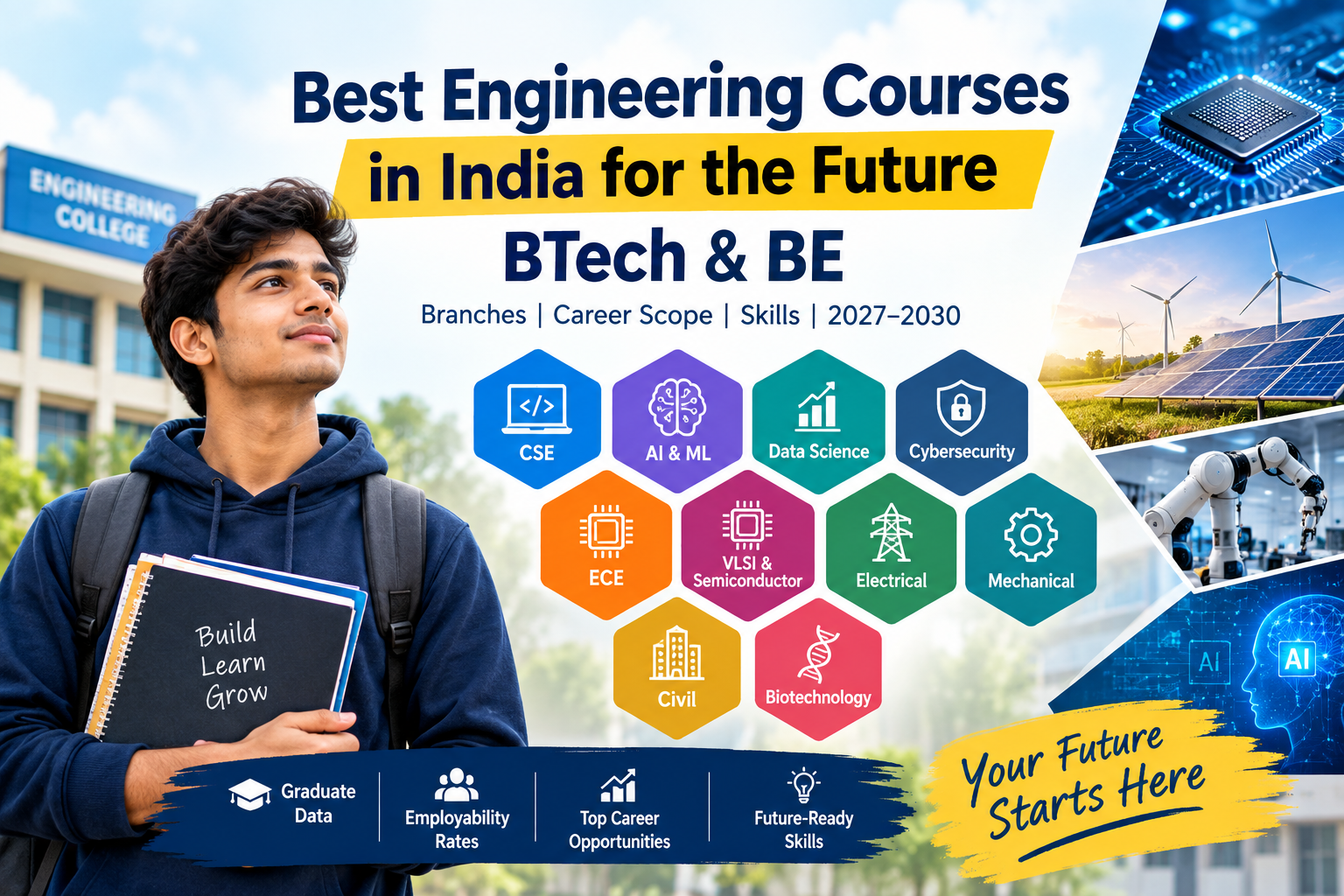
Best Engineering Courses in India for the Future: BTech & BE Branches to Consider in 2027–2030
Choosing the best engineering courses in India is an important decision after Class 12. For 2027–2030, students can explore BTech and BE branches such as Computer Science, Artificial Intelligence, Data Science, Cybersecurity, Electronics and Communication, VLSI, Electrical, Mechanical, Civil and Biotechnology. However, there is no single engineering branch that is best for every student. Your choice should depend on your interests, academic strengths, college quality, practical skills, fees, internships and career goals.
Engineering careers are also changing quickly. Software, AI, data, cybersecurity, semiconductor design, electric vehicles, renewable energy, automation, advanced manufacturing and infrastructure are creating different career paths. Therefore, this guide compares the best engineering courses in India using graduate data, employability information, industry developments, required skills and career opportunities.
There is no single answer for every student. A good engineering choice depends on your interests, skills, college, fees, practical training, internships and career goals.
However, current data can help students understand where the industry is moving.
Between 2027 and 2030, important areas are likely to include software, artificial intelligence, data, cybersecurity, electronics, semiconductor design, electric vehicles, renewable energy, automation, robotics, manufacturing and infrastructure.
The latest education data also shows the size of India’s engineering sector. AISHE 2023–24 reported about 8.2 lakh BE/BTech graduates in the year.
At the same time, India Skills Report data shows differences in employability across engineering fields.
Therefore, this guide looks at the best engineering courses in India for the future using graduate data, employability data, industry changes and practical career factors.
Important: No engineering branch is 100% future-proof. Also, employability does not mean guaranteed placement. Before taking admission, check approval, fees, faculty, labs, internships and branch-wise placement data.
Best Engineering Courses in India: What the Latest Data Shows
The latest education data helps students understand the scale of engineering education in India and why choosing among the best engineering courses in India requires more than looking at one placement figure.
India has one of the world’s largest higher-education systems. Engineering is also one of the major areas of study.
According to AISHE 2023–24, around 8.2 lakh students graduated from BE/BTech programmes during the year.
That number shows the size of India’s engineering talent pool.
However, it also means that competition can be high. A degree alone may not be enough. Students should build practical skills along with their college education.
For example, useful skills can include:
- Programming
- Data analysis
- AI tools
- Cloud computing
- Cybersecurity
- CAD and design
- Electronics
- Automation
- Communication
- Problem-solving
Major Engineering Graduate Numbers
AISHE 2023–24 data reported the following graduate numbers for major engineering disciplines:
| Engineering discipline | Graduates in 2023–24 |
|---|---|
| Computer Engineering | 2,62,408 |
| Mechanical Engineering | 1,13,390 |
| Electronics Engineering | 1,11,242 |
| Civil Engineering | 88,839 |
| Electrical Engineering | 72,062 |
These numbers show the size of the graduate pipeline. They do not represent the number of available jobs or the number of students placed.
Engineering Employability: What the India Skills Report Shows
Another useful source is the India Skills Report.
However, students should understand what its percentage means.
The report uses an employability assessment. Therefore, its figures should not be treated as national placement rates.
India Skills Report 2025
The 2025 report showed the following employability figures for selected engineering areas:
| Engineering / technical domain | Employability |
|---|---|
| Computer Science | 78% |
| Information Technology | 75% |
| Electronics & Communication Engineering | 72% |
| BE/BTech overall | 71.5% |
| Electrical Engineering | 68% |
| Biotechnology Engineering | 65% |
| Mechanical Engineering | 60% |
These numbers come from the report’s employability assessment. They do not mean that the same percentage of students received jobs.
Therefore, students should use these figures as one source of information rather than as a placement guarantee.
India Skills Report 2026: New Employability Numbers
The newer India Skills Report 2026 gives another view of the engineering talent market.
The report shows:
| Domain | 2026 employability |
|---|---|
| Computer Science | 80% |
| Information Technology | 78% |
| Instrumentation Engineering | 77% |
| Electronics & Communication | 75% |
| Mechanical Engineering | 63% |
| BE/BTech overall | 70.15% |
Again, these are assessment-based employability figures. They are not placement percentages.
For example, Computer Science moved from 78% in the 2025 report to 80% in the 2026 report. ECE moved from 72% to 75%.
The figures can change from year to year. Therefore, students should look at the wider picture instead of relying on one number.
What Will Shape Engineering Careers from 2027 to 2030?
Technology and industry are changing quickly.
Several areas are receiving strong attention in India, including:
- Artificial Intelligence
- Machine Learning
- Data Science
- Cloud computing
- Cybersecurity
- Electronics
- Semiconductor design
- VLSI
- Embedded systems
- Electric vehicles
- Battery technology
- Renewable energy
- Robotics
- Industrial automation
- Advanced manufacturing
- Infrastructure
In addition, government programmes are supporting some of these sectors.
AI Education Is Becoming More Practical
Artificial Intelligence is becoming part of many engineering programmes.
In 2026, the Government of India discussed changes to AI education with industry participation. The work focused on practical learning, industry projects, faculty training and better access to infrastructure.
The proposed changes also discussed increasing practical exposure from about 25–30% to 40–75%, depending on the degree and specialisation.
This gives students an important message: learning AI is not only about theory. Practical work will also matter.
1. Computer Science Engineering: Software and Technology Careers
Computer Science Engineering, or CSE, is one of the largest engineering fields in India.
AISHE 2023–24 reported around 2,62,408 Computer Engineering graduates.
The India Skills Report 2025 reported 78% employability for Computer Science. The 2026 report reported 80%.
These figures are based on employability assessments, not placement data.
Why CSE remains important
Software is now used across many industries.
For example:
- Banking
- Healthcare
- Retail
- Manufacturing
- Logistics
- Education
- E-commerce
- Telecommunications
- Government services
As a result, CSE graduates can explore many career paths.
Career roles after CSE
Possible roles include:
- Software engineer
- Full-stack developer
- Backend developer
- Frontend developer
- Mobile-app developer
- Cloud engineer
- DevOps engineer
- QA automation engineer
- Data engineer
- Product engineer
- Technical consultant
Important CSE skills
Students can build skills in:
- Python
- Java
- C++
- JavaScript
- SQL
- Data structures
- Algorithms
- Git and GitHub
- APIs
- Cloud computing
- Software testing
- Databases
Who may consider CSE?
CSE may suit students who enjoy:
- Coding
- Computers
- Mathematics
- Logical thinking
- Problem-solving
However, students should not choose CSE only because it is popular. Programming skills and practical projects are important.
2. Artificial Intelligence and Machine Learning
Artificial Intelligence and Machine Learning are becoming important parts of technology.
AI is being used in:
- Banking
- Healthcare
- Retail
- Manufacturing
- Logistics
- Education
- Cybersecurity
- Computer vision
- Natural language processing
Important AI skills
Students may need:
- Python
- Mathematics
- Statistics
- Probability
- Data structures
- Machine learning
- Deep learning
- Data analysis
- Natural language processing
- Computer vision
Career roles
Possible roles include:
- AI engineer
- Machine-learning engineer
- MLOps engineer
- Data scientist
- Data engineer
- Computer-vision engineer
- NLP engineer
- AI product associate
- Analytics engineer
An important reality about AI careers
Most fresh graduates do not begin their careers as advanced AI researchers.
Instead, many may first work in areas such as:
- Software development
- Data analysis
- Data engineering
- Testing
- Automation
Therefore, strong programming and mathematics remain important.
3. Data Science: For Students Who Like Numbers
Data Science combines mathematics, statistics, programming and business knowledge.
Companies collect data from:
- Websites
- Mobile apps
- Payments
- Sales
- Machines
- Customer activity
- Digital services
The challenge is turning that data into useful information.
Important Data Science skills
Students can learn:
- Python
- SQL
- Excel
- Statistics
- Power BI
- Tableau
- Data visualisation
- Databases
- Cloud basics
- Business communication
Career roles
Possible roles include:
- Data analyst
- Business analyst
- Data engineer
- BI developer
- Product analyst
- Operations analyst
- Analytics engineer
- Junior data scientist
Students who enjoy numbers, statistics and analysis may find this field interesting.
4. Cybersecurity Engineering
Cybersecurity has become important because companies now depend on digital systems.
These include:
- Cloud systems
- Online payments
- Mobile applications
- Customer databases
- Digital identities
- Connected devices
Cybersecurity professionals help protect these systems.
Important cybersecurity skills
Students should learn:
- Computer networks
- Operating systems
- Linux
- Programming
- Cloud security
- Cryptography
- Application security
- Digital forensics
- Incident response
- Security operations
Career roles
Possible roles include:
- Cybersecurity analyst
- SOC analyst
- Security engineer
- Penetration tester
- Ethical hacker
- Network-security engineer
- Cloud-security associate
- Digital-forensics analyst
- Application-security engineer
- Risk and compliance associate
A short cybersecurity certificate alone may not be enough. Strong computer and networking basics are also important.
5. Electronics and Communication Engineering
Electronics and Communication Engineering, or ECE, is useful for students interested in:
- Circuits
- Electronics
- Communication
- Embedded systems
- Hardware
- Chips
- Sensors
AISHE 2023–24 reported around 1,11,242 Electronics Engineering graduates.
The India Skills Report showed 72% employability for ECE in 2025 and 75% in 2026.
Career areas after ECE
Students can explore:
- Semiconductor design
- VLSI
- Embedded systems
- Telecom
- IoT
- Automotive electronics
- Medical devices
- Consumer electronics
- Industrial automation
- Aerospace and defence electronics
Why ECE is important in 2026
India is investing heavily in semiconductors.
Semicon 2.0 was approved with a total budget outlay of ₹1,27,500 crore. The programme covers six areas:
- Chip design
- Machines and materials
- Semiconductor fabs
- ATMP and OSAT
- Research and development
- Talent development
As a result, students interested in ECE, electronics and chip design have several new areas to explore.
Labs to check before admission
Look for:
- Electronics laboratories
- Communication laboratories
- Embedded kits
- Microcontrollers
- PCB design tools
- FPGA access
- Simulation software
- Industry projects
- Internship support
6. VLSI and Semiconductor Engineering
VLSI means Very Large Scale Integration.
It deals with the design and development of integrated circuits and chips.
These chips are used in:
- Smartphones
- Computers
- Vehicles
- Communication systems
- Industrial machines
- AI systems
- Consumer electronics
VLSI is often linked with ECE and Electronics Engineering. Some colleges also offer specialised VLSI programmes.
India’s semiconductor numbers in 2026
The semiconductor sector has seen several major developments.
Under the semiconductor programme:
- 12 semiconductor projects were approved.
- Investment commitments exceeded ₹1.64 lakh crore.
- 24 chip-design projects were approved.
- 105 startups had access to advanced chip-design tools.
- Five semiconductor manufacturing plants had commenced commercial production by September 2026.
Semicon 2.0 has a total outlay of ₹1,27,500 crore.
Semiconductor talent
The government also reported:
- Around 70,000 design engineers trained in four years
- Around 400 engineering colleges with access to industry-grade EDA tools
- More than 105 chip-design startups with access to advanced EDA tools
- A target of at least 200 chip-design companies
- More than 300 chip designs developed
India also has nearly 20% of the global semiconductor chip-design workforce, according to the government backgrounder.
These figures do not guarantee semiconductor jobs for every ECE or VLSI graduate. They do, however, show the scale of investment and skill development in the sector.
Career roles in VLSI
Students can explore:
- VLSI design engineer
- ASIC engineer
- Verification engineer
- Physical-design engineer
- FPGA engineer
- Semiconductor test engineer
- Chip-validation engineer
- Embedded hardware engineer
VLSI may suit students who enjoy electronics, digital logic, mathematics and detailed technical work.
7. Electrical Engineering: EVs, Power and Renewable Energy
Electrical Engineering remains important for India’s energy and transport systems.
AISHE 2023–24 reported around 72,062 Electrical Engineering graduates.
The India Skills Report 2025 reported 68% employability for Electrical Engineering.
Career areas
Electrical engineers can work in:
- Power systems
- Renewable energy
- Electric vehicles
- Battery technology
- Power electronics
- Industrial automation
- Smart grids
- Solar energy
- Electrical design
Modern electrical engineering also connects with EVs, batteries, automation and renewable energy.
Useful skills
Students can learn:
- Power electronics
- PLC
- SCADA
- Industrial automation
- Solar-system design
- EV fundamentals
- Battery-management systems
- Electrical design software
- Data analysis
8. Mechanical Engineering and Mechatronics
Mechanical Engineering remains one of India’s largest engineering fields.
AISHE 2023–24 reported around 1,13,390 Mechanical Engineering graduates.
The India Skills Report reported 60% employability in 2025 and 63% in 2026 for Mechanical Engineering.
Career areas
Mechanical engineers can work in:
- Manufacturing
- Automotive
- Aerospace
- Product design
- Production
- Industrial plants
- Automation
- Robotics
- Maintenance
Mechatronics
Mechatronics combines:
- Mechanical engineering
- Electronics
- Sensors
- Control systems
- Programming
- Automation
Therefore, it can be useful for students interested in robotics and smart manufacturing.
Career roles
Possible roles include:
- Design engineer
- Manufacturing engineer
- Production engineer
- Quality engineer
- CAD/CAE engineer
- Automation engineer
- Robotics engineer
- Automotive engineer
- Maintenance engineer
- HVAC engineer
Useful skills
Students can learn:
- AutoCAD
- SolidWorks
- CATIA
- ANSYS
- CNC
- PLC
- Robotics
- Industrial automation
- 3D printing
9. Civil Engineering
Civil Engineering remains important for infrastructure and construction.
India needs engineers for:
- Roads
- Bridges
- Railways
- Metro systems
- Airports
- Housing
- Warehouses
- Water infrastructure
- Industrial projects
AISHE 2023–24 reported around 88,839 Civil Engineering graduates.
Career roles
Civil Engineering graduates can explore:
- Site engineer
- Structural engineer
- Project engineer
- Quantity surveyor
- Planning engineer
- BIM engineer
- Geotechnical engineer
- Water-resources engineer
- Construction manager
Useful Civil Engineering skills
Students can learn:
- AutoCAD
- Revit
- BIM
- STAAD.Pro
- Estimation
- Costing
- Quantity surveying
- Project planning
10. Biotechnology Engineering
Biotechnology Engineering is suitable for students interested in biology, chemistry and laboratory work.
The India Skills Report 2025 reported 65% employability for Biotechnology Engineering.
Career areas include:
- Biotechnology
- Pharmaceuticals
- Diagnostics
- Food technology
- Research
- Laboratory work
- Bioinformatics
- Healthcare technology
For some specialised research careers, postgraduate education may also be useful.
Engineering Branch Comparison
| Branch | Graduate data | 2025 employability | 2026 employability | Major future areas | Main skills |
|---|---|---|---|---|---|
| CSE / Computer Engineering | 2,62,408 | 78% | 80% | Software, cloud, AI, data | Coding, algorithms |
| ECE / Electronics | 1,11,242 | 72% | 75% | Chips, embedded, telecom, IoT | Electronics, programming |
| Mechanical | 1,13,390 | 60% | 63% | Manufacturing, robotics, automation | CAD, manufacturing |
| Civil | 88,839 | — | — | Infrastructure, construction, BIM | Design, planning |
| Electrical | 72,062 | 68% | — | EVs, power, energy | Power systems, automation |
| Biotechnology | — | 65% | — | Pharma, diagnostics, research | Biology, laboratory work |
| IT | — | 75% | 78% | Software, cloud, digital services | Coding, databases |
| Instrumentation | — | — | 77% | Automation, control systems | Sensors, control |
Note: Graduate numbers come from AISHE 2023–24. Employability percentages come from the India Skills Reports. These datasets measure different things, so they should not be used to calculate placement chances.
What Should You Check Before Choosing an Engineering College?
The branch name is only one part of the decision.
A college may advertise AI, Robotics, VLSI or Cybersecurity. However, the actual quality depends on teaching, labs and practical training.
Check these facilities
| Branch | Facilities to check |
|---|---|
| CSE / AI / Data Science | Coding labs, cloud access, project mentoring, technical clubs |
| Cybersecurity | Networking labs, security labs, controlled practice systems |
| ECE / VLSI | Electronics labs, PCB tools, embedded kits, FPGA, simulation tools |
| Electrical | Machines labs, power-electronics labs, automation, EV exposure |
| Mechanical / Robotics | Workshops, CNC, CAD/CAE, PLC, 3D printing, robotics |
| Civil | Surveying, material testing, structural labs, BIM, site visits |
| Biotechnology | Wet labs, instruments, bioinformatics, research facilities |
Questions to Ask Before Paying the Admission Fee
Before choosing a college, ask:
- Is the college properly approved or affiliated?
- What is the complete four-year fee?
- What are the hostel and other charges?
- What is the branch-wise placement record?
- What is the median salary?
- Which companies recruit from the branch?
- How many students are in the batch?
- How many students receive internships?
- Are the laboratories available for regular student use?
- Does the college have industry partnerships?
- Are technical clubs active?
- Are hackathons conducted?
- What projects do students complete?
- How many faculty members teach the branch?
- What is the student-to-faculty ratio?
Most importantly, do not judge a college only by its highest package.
The median salary and branch-wise placement data usually provide more useful information.
BTech vs BE: What Should Students Compare?
Students often ask whether BTech is better than BE.
In practice, the degree name should not be the only factor.
Instead, compare:
| Factor | What to check |
|---|---|
| University | Recognition and affiliation |
| Branch | Curriculum and specialisation |
| Faculty | Experience and availability |
| Labs | Practical facilities |
| Fees | Total four-year cost |
| Internship | Industry exposure |
| Placement | Branch-wise results |
| Curriculum | Current skills and subjects |
| Projects | Practical learning |
| Higher studies | Future academic options |
Therefore, compare the actual college and programme rather than choosing only because the degree says BTech or BE.
How to Choose the Best Engineering Course for Your Future:
If you enjoy coding
Consider:
- CSE
- IT
- AI/ML
- Data Science
- Cybersecurity
If you enjoy electronics
Consider:
- ECE
- Electronics
- VLSI
- Embedded systems
If you enjoy electricity and power
Consider:
- Electrical Engineering
- Power Engineering
- Renewable energy-related areas
If you enjoy machines
Consider:
- Mechanical Engineering
- Mechatronics
- Robotics
- Manufacturing
If you enjoy construction
Consider:
- Civil Engineering
- Structural Engineering
- Construction management
- BIM
If you enjoy biology and laboratory work
Consider:
- Biotechnology
- Biomedical-related areas
- Bioinformatics
The important point is to match the course with your interests and strengths.
Don’t Choose an Engineering Branch Only for the Highest Package
A high package shown in an advertisement may belong to a small number of students.
For that reason, students should ask for:
- Number of students placed
- Number of students in the batch
- Median salary
- Average salary
- Branch-wise placement
- Internship numbers
- Recruiting companies
Also, look at your own interests.
For example, a student who dislikes coding may struggle in CSE even if the field has strong software demand.
Similarly, a student who dislikes electronics may not enjoy ECE or VLSI.
The Future of Engineering Will Be More Skill-Based
The engineering degree gives students a foundation.
Practical skills can then help them build a career.
For example:
CSE + AI
ECE + VLSI
Electrical + EV
Mechanical + Robotics
Civil + BIM
Data Science + Business Analytics
Cybersecurity + Cloud
These combinations can help students connect traditional engineering knowledge with newer technologies.
As a result, students should start building projects and practical skills during college rather than waiting until the final semester.
Final Thoughts
The question “Which engineering course is best for the future?” does not have one answer for every student.
Current data gives us several useful signals.
Computer Engineering had around 2,62,408 graduates in 2023–24. Mechanical had around 1,13,390, Electronics around 1,11,242, Civil around 88,839, and Electrical around 72,062.
The India Skills Report also shows different employability figures across engineering fields. Computer Science was reported at 78% in 2025 and 80% in 2026, while ECE moved from 72% to 75%. Mechanical moved from 60% to 63%.
Meanwhile, India’s semiconductor sector is receiving major investment. Semicon 2.0 has a total outlay of ₹1,27,500 crore. By September 2026, the government reported five semiconductor manufacturing plants in commercial production, around 70,000 design engineers trained in four years, and access to industry-grade EDA tools for around 400 engineering colleges.
AI education is also becoming more practical, with the government working with industry to update AI curricula and increase practical exposure.
Therefore, the best engineering course for a student depends on four major things:
Interest + Skills + College Quality + Career Goal
CSE may suit a student who enjoys software.
AI/ML may suit someone who enjoys mathematics, programming and data.
ECE and VLSI may suit students interested in electronics and chips.
Electrical Engineering may suit students interested in power, EVs and renewable energy.
Mechanical and Mechatronics may suit students interested in machines, manufacturing and robotics.
Civil Engineering may suit students interested in construction and infrastructure.
Biotechnology may suit students interested in biology and laboratory work.
The branch is the starting point. Skills, projects, internships and practical experience can make the bigger difference later.
Government of India’s Semicon 2.0 announcement
Frequently Asked Questions
Which engineering course has the most future scope in India?
There is no single course that has the same future scope for every student.
CSE, AI/ML, Data Science, Cybersecurity, ECE, VLSI, Electrical, Mechanical, Mechatronics, Civil and Biotechnology all connect with different industries.
Therefore, compare the course with your interests, skills and career goals.
Which engineering branch has the highest employability?
The India Skills Report 2026 reported 80% for Computer Science, 78% for IT, 77% for Instrumentation Engineering, 75% for ECE and 63% for Mechanical Engineering.
These are employability assessment figures, not national placement rates.
The 2025 report reported 78% for Computer Science, 75% for IT, 72% for ECE, 68% for Electrical, 65% for Biotechnology and 60% for Mechanical Engineering.
Is CSE still useful for 2027–2030?
CSE continues to have a large graduate base and strong employability assessment results.
However, competition can also be high. Therefore, students should learn programming, software development and practical tools.
Is AI/ML better than CSE?
They are different areas.
CSE generally provides broader computer-science knowledge. AI/ML focuses more on mathematics, data and machine-learning systems.
The better fit depends on the student’s interests and the actual curriculum.
Does ECE have future scope?
Yes, ECE connects with areas such as semiconductors, VLSI, embedded systems, telecom, IoT and automotive electronics.
India’s semiconductor investment also makes this area worth researching.
Is VLSI a good option?
VLSI is a specialised field for students interested in electronics, digital logic and chip design.
Students should check whether the college has FPGA tools, EDA software, labs and industry projects.
Is Electrical Engineering useful for the future?
Electrical Engineering connects with power systems, renewable energy, EVs, batteries, power electronics and automation.
AISHE 2023–24 reported around 72,062 Electrical Engineering graduates.
Is Mechanical Engineering still relevant?
Mechanical Engineering remains connected with manufacturing, automotive, product design, automation and robotics.
AISHE 2023–24 reported around 1,13,390 Mechanical Engineering graduates.
Is Civil Engineering still relevant?
Civil Engineering remains connected with construction, infrastructure, transportation, water systems and large projects.
AISHE 2023–24 reported around 88,839 Civil Engineering graduates.
Is BTech better than BE?
The degree name alone should not decide the choice.
Compare the university, branch, curriculum, faculty, labs, fees, internships and placement data.
Can students get good jobs from a non-IIT college?
Career outcomes vary by college, branch, skills and individual preparation.
Therefore, students should check actual branch-wise placement data and build strong practical skills.
What skills should engineering students learn?
Depending on the branch, students can develop:
- Programming
- AI
- Data analytics
- Cloud computing
- Cybersecurity
- VLSI
- Embedded systems
- CAD/CAE
- PLC
- Robotics
- Automation
- BIM
- Communication
- Problem-solving
What should parents check before admission?
Parents should check:
- Approval or affiliation
- Complete fees
- Branch-wise placement data
- Median salary
- Internship record
- Faculty
- Laboratories
- Batch size
- Student projects
- Industry partnerships
- Hostel and other costs
Do not depend only on advertisements showing the highest package.
Related Admission Mantra Guides
If you are also planning engineering admission in Karnataka, read our detailed guide on Engineering Admissions in Karnataka: College, Branch & Counselling Guide to understand branch selection, college choice, counselling and option entry.
Link:
Engineering Admissions in Karnataka: College, Branch & Counselling Guide
The latest Karnataka admission data also shows that students are becoming more selective about engineering branches and colleges. Read our analysis of 24,283 Engineering Seats Vacant in Karnataka in 2026 to understand the latest admission trend.
Link:
24,283 Engineering Seats Vacant in Karnataka 2026: Why Are More Seats Going Unfilled?
Admission Mantra helps students and parents understand courses, colleges, admission processes and career choices before making an education decision.