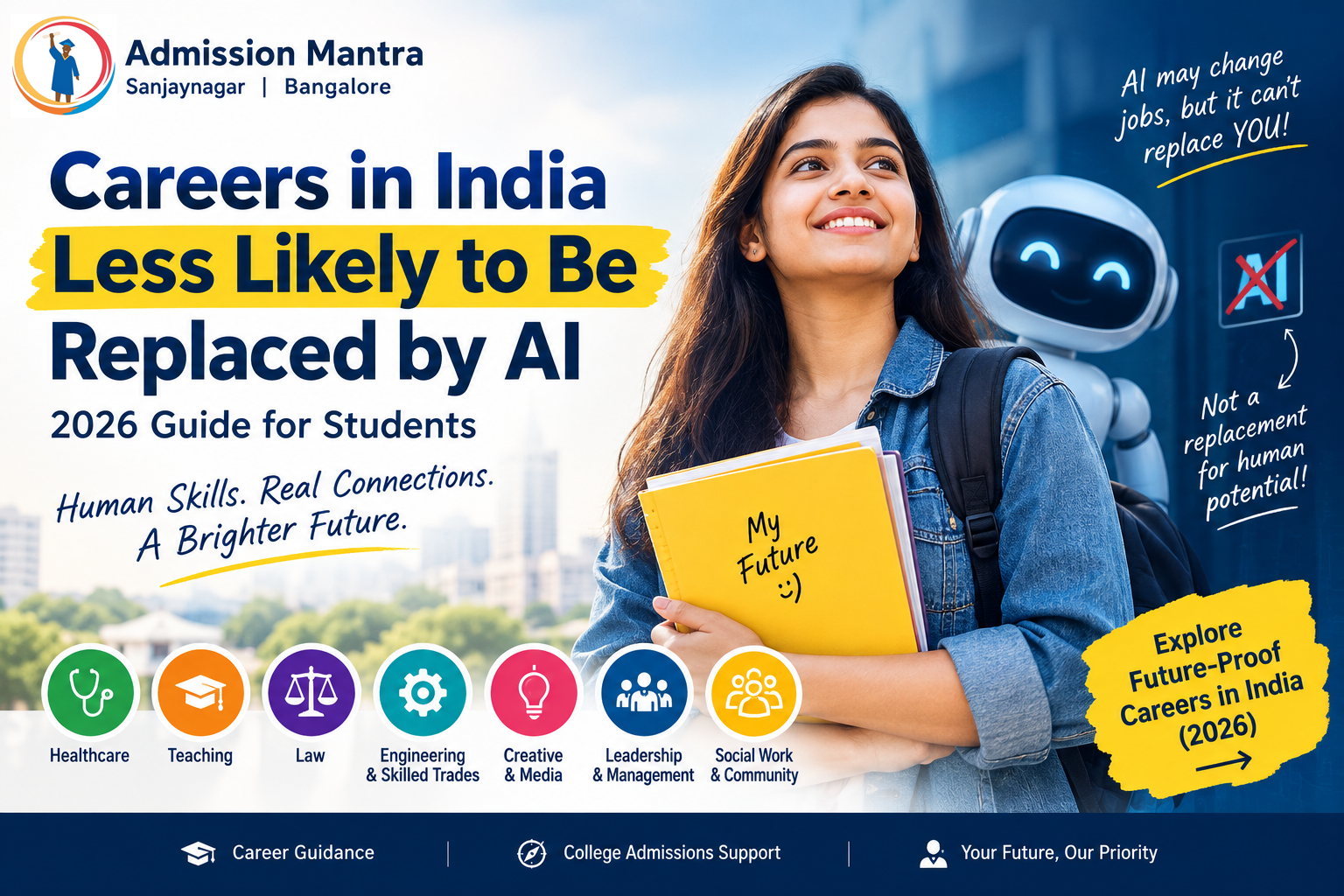
Careers in India Less Likely to Be Replaced by AI: 2026 Guide for Students
Students and parents are increasingly searching for careers less likely to be replaced by AI in India as technology changes the job market.
Artificial Intelligence is changing the way people study and work. Today, AI can answer questions, write text, create pictures, check data and help with many daily tasks. Because of this, many students and parents are worried about future jobs.
However, the future is not as simple as “AI will take all the jobs.”
Some tasks may be done by AI. At the same time, many jobs may change rather than disappear. In addition, new types of work can grow as technology improves.
Understanding careers less likely to be replaced by AI in India starts with knowing which types of work still need human judgment.
The International Labour Organization says that AI is more likely to change many jobs than fully remove them. Therefore, students should focus on careers where people still need knowledge, judgment, practical skills and human contact.
The most useful question is not:
“Which job will AI never replace?”
Instead, ask:
“Which career can grow with technology while still needing strong human skills?”
Overall, that question can help students make a better career choice in 2026.
How AI Is Changing Jobs in India
AI is good at many tasks.
For example, it can sort information, answer common questions, write simple reports and check large amounts of data.
It can also create basic content, support customer service and help with computer code.
However, doing one task is not the same as doing an entire job.
A doctor may use AI to find information. Still, the doctor has to talk to the patient, understand the problem and make the final decision.
A teacher may use AI to prepare study material. Even so, the teacher still needs to understand the student and give guidance.
A lawyer may use AI to find documents. However, the lawyer still needs to understand the case and advise the client.
As a result, students should learn the difference between task automation and job replacement.
The World Economic Forum also expects technology skills to become more important. At the same time, skills such as clear thinking, creativity, teamwork and leadership remain useful.
Source:
https://www.weforum.org/publications/the-future-of-jobs-report-2025/
Top Careers Less Likely to Be Replaced by AI in India
No career can be called completely safe from AI.
Still, some types of work are harder to do fully with software.
Human contact
People often want to speak with another person when the issue is important, personal or difficult.
Practical work
For example, work in hospitals, workshops, buildings, labs and other real places can be hard to do only with software.
Human judgment
Real problems do not always have one clear answer. As a result, people often need to compare choices and decide what to do.
Responsibility
Some jobs require a trained person to take responsibility for the final decision.
Trust
In addition, patients, students, clients and families often need care, support and trust.
Creative thinking
AI can create many ideas. However, people still need to decide which idea is useful and right for the situation.
Leadership
Teams need people who can guide others, solve problems and take responsibility.
Therefore, careers that combine knowledge + people skills + practical work + technology may offer good long-term value.
1. Healthcare Careers
Healthcare is one of the major areas students can consider when looking at careers less likely to be replaced by AI in India.
AI can help with research, records, data and other tasks. However, patients still need trained people for care, communication and many medical decisions.
Healthcare careers students can explore
- Doctors
- Nurses
- Physiotherapists
- Medical laboratory professionals
- Radiology professionals
- Optometrists
- Pharmacists
- Respiratory care professionals
- Cardiac care professionals
- Public health professionals
- Hospital management professionals
For example, a patient may need an examination, an explanation and personal care. In addition, the patient may need help when the situation changes.
Therefore, AI can be a useful tool for healthcare workers, but it does not remove the need for people.
Students should also remember that healthcare is much bigger than MBBS.
Read our guide:
Courses Without NEET in India: 10 Healthcare Careers to Explore in 2026
For medical education rules, students should also check the National Medical Commission:
2. Nursing and Allied Health Careers
Next, nursing and allied health courses deserve special attention because they include direct patient care and practical work.
For example, a nurse may check a patient, provide care and report changes to a doctor. Similarly, a physiotherapist may assess movement and plan exercises.
As a result, these jobs need both knowledge and human contact.
Students can explore courses such as:
- B.Sc Nursing
- BPT
- Medical Laboratory Technology
- Medical Imaging Technology
- Respiratory Care Technology
- Cardiac Care Technology
- Anaesthesia Technology
- Operation Theatre Technology
- Optometry
- Pharmacy
However, admission rules can be different for each course.
Therefore, students should always check the latest rules of the college, university and relevant authority.
3. Teaching and Education Careers
Teaching is another field often included among careers less likely to be replaced by AI in India because it depends heavily on human interaction.
For example, AI tutors can answer questions.
In addition, online tools can provide lessons.
However, teaching is much more than giving information.
A teacher has to understand the student. At the same time, the teacher may need to explain the same topic in a different way.
For example, one student may need more practice. Another may need more confidence. Someone else may need help with study habits.
Career options include:
- School teacher
- College lecturer
- Professor
- Academic mentor
- Career counsellor
- Special educator
- Education administrator
- Training professional
As AI becomes more common, teachers may use it for lesson planning, practice work and other tasks.
Even so, the human side of teaching remains important.
4. Law and Legal Careers
Similarly, AI can help lawyers search information and prepare documents.
However, legal work also needs reading, thinking, communication and judgment.
For example, a lawyer may need to understand a client’s problem. Then, the lawyer may need to explain the options and discuss the next step.
Career options include:
- Advocate
- Corporate lawyer
- Legal advisor
- Legal researcher
- Compliance professional
- Contract specialist
- Policy professional
Students can explore courses such as:
- BA LLB
- BBA LLB
- BCom LLB
- LLB after graduation
- LLM
Therefore, students who enjoy reading, writing, logic, discussion and argument can consider law.
5. Engineering and Technology Careers
Students should also understand that some engineering paths can become careers less likely to be replaced by AI in India when strong technical skills are combined with practical experience.
Engineering will also change because of AI.
However, that does not mean students should avoid engineering.
In fact, new technology can create new engineering work.
Students can explore:
- Computer Science Engineering
- Artificial Intelligence and Machine Learning
- Data Science
- Cybersecurity
- Electronics and Communication
- VLSI
- Electrical Engineering
- Mechanical Engineering
- Civil Engineering
- Mechatronics
- Robotics
- Renewable Energy
- EV-related technology
For example, a mechanical engineer can learn automation. Similarly, an electronics student can learn embedded systems.
As a result, the stronger choice is often:
Core subject knowledge + modern technology skills
Students can also read:
24,283 Engineering Seats Are Still Vacant in Karnataka in 2026
In addition, this guide can help students understand why choosing the right branch and college matters.
6. Skilled Trades and Technical Careers
However, students sometimes think only degree-based jobs have a future.
In reality, that is not true.
Instead, many skilled jobs need physical work and on-site problem-solving.
Examples include:
- Electricians
- Plumbers
- Automobile technicians
- HVAC technicians
- Industrial technicians
- Welders
- Carpenters
- Machine maintenance workers
- Construction technicians
For example, consider an electrician working in an old building.
In that situation, the wiring may be different from the original plan. Therefore, the technician must inspect the site and find the real problem.
After that, the technician has to repair it safely.
As a result, this kind of work combines knowledge, physical skill and problem-solving.
Students can explore:
- ITI
- Diploma courses
- Polytechnic
- Apprenticeships
- Technical training
In addition, NITI Aayog also highlights skills, apprenticeships and links between education and employment.
Source:
https://www.niti.gov.in/node/2397
7. Psychology and Counselling Careers
In some cases, AI can provide information and simple support.
However, human behaviour is complex.
Therefore, people may need someone who can listen, understand their situation and provide professional help.
Career areas include:
- Psychology
- Counselling
- Rehabilitation
- Student support
- Behaviour support
- Community services
Students must check the rules for the exact career they want to enter.
For example, different psychology roles can have different study and registration requirements.
Therefore, do not choose a course until you understand the full career path.
8. Creative Careers
Today, AI can create pictures, videos, text and other content.
Because of this, creative work is changing fast.
Even so, creative work is not only about making content.
Instead, it also includes:
- Ideas
- Storytelling
- Brand understanding
- Audience understanding
- Design sense
- Creative direction
- Communication
Students can explore:
- Graphic Design
- UI/UX Design
- Product Design
- Film
- Video Editing
- Animation
- Advertising
- Branding
- Fashion Design
- Content Strategy
For example, AI may create ten design ideas in seconds.
However, a human still needs to decide which idea fits the brand and the audience.
Therefore, students should build creativity first and then learn AI tools.
9. Management and Leadership Careers
For example, AI can study data and suggest options.
However, companies still need people to lead teams.
A manager may need to solve a conflict. In another case, the manager may need to decide how to use limited money or time.
Career options include:
- Business Manager
- Project Manager
- Product Manager
- HR Professional
- Operations Manager
- Sales Leader
- Entrepreneur
- Business Consultant
Students can explore:
- BBA
- BCom
- BMS
- MBA
- PGDM
- Entrepreneurship programmes
In addition, students should build communication, teamwork and leadership skills.
10. Social Work and Community Careers
In addition, some careers depend on direct contact with people and communities.
For example, these include:
- Social workers
- NGO professionals
- Community development workers
- Rural development professionals
- Public health workers
- Rehabilitation workers
- Community outreach workers
AI can help with records and data.
However, building trust in a community takes time and human contact.
Therefore, these careers continue to need people.
11. Hospitality, Tourism and Service Careers
Meanwhile, technology is changing hotels, travel and customer service.
For example, companies now use software for:
- Booking
- Payment
- Customer messages
- Marketing
- Data
Even so, guests still value personal service.
Career options include:
- Hotel Management
- Hospitality Management
- Travel and Tourism
- Event Management
- Food Service Management
- Customer Experience
Therefore, students who enjoy people, travel, service and organisation can explore this area.
As a result, students should focus on building skills that can support careers less likely to be replaced by AI in India.
Which Jobs May Face More AI Changes?
However, students should also understand the other side.
In general, jobs are easier to automate when the work is very repetitive.
For example, this can include some forms of:
- Data entry
- Basic document work
- Routine reporting
- Simple customer support
- Repetitive office work
- Basic content work
Still, this does not mean every job in these areas will disappear.
Instead, many workers may see some tasks change.
The ILO makes this same point in its research on AI and jobs.
Source:
https://www.ilo.org/publications/generative-ai-and-jobs-2025-update
The Real Career Question Students Should Ask
Students should not ask only:
“Will AI replace this job?”
Instead, ask these questions:
Does this career need human contact?
What level of judgment does it require?
Is practical work part of the job?
Does the career involve real responsibility?
Can I use AI to improve my work?
Will I need to keep learning?
Overall, if the answer is yes to several of these questions, the career may have good room for human value even as AI grows.
Careers That Can Grow With AI
Importantly, students do not always have to choose between “AI” and “human work.”
In many cases, the two can work together.
For example:
Healthcare + AI
Doctors and healthcare workers can use AI tools to support their work.
Engineering + Automation
Engineers can work with smart machines and automated systems.
Law + Technology
Lawyers can use digital tools for research and document work.
Education + AI
Teachers can use AI for study material and learning support.
Design + AI
Designers can use AI to create and test ideas faster.
Business + Data
Managers can use data and AI tools to make better decisions.
As a result, learning to work with AI can be just as important as choosing a career that uses human skills.
Step-by-Step Career Planning for Students in 2026
Choosing a career is a big decision.
Therefore, do not choose a course only because someone says it has a “high salary.”
Instead, use the steps below.
Step 1: Understand Your Interests
First, ask yourself:
- Which subjects do I enjoy?
- Do I understand those subjects well?
- Would I enjoy working with people?
- How do I feel about technology?
- Do I enjoy practical work?
- Could business be interesting to me?
- Is creativity important to me?
- Do I enjoy science?
Then, write down your answers.
This small step can help you see your strong areas.
Step 2: Choose a Career Family
Next, choose a broad career area.
For example:
| Student Interest | Career Areas |
|---|---|
| Biology + patient care | Medicine, Nursing, Allied Health |
| Biology + lab work | Medical Lab, Biotechnology |
| Maths + technology | Engineering, Data, AI |
| Reading + argument | Law |
| Teaching + subject knowledge | Education |
| Creativity + technology | Design, Media |
| Business + leadership | BBA, BCom, MBA |
| Practical work | ITI, Diploma, Technical Courses |
| People + social service | Psychology, Social Work |
| Travel + service | Hospitality, Tourism |
At this stage, do not rush to choose a college.
Instead, decide what type of work suits you.
Step 3: Check Your Class 12 Eligibility
After that, check the course rules.
Look at:
- Required subjects
- Minimum marks
- Entrance exam
- Age rules, if any
- State rules
- College rules
- Course approval
For example, medical, engineering and law courses can have different admission rules.
Therefore, always check the latest official information.
Step 4: Check the Entrance Exam
Depending on the course, you may need:
- NEET-UG
- JEE Main
- KCET
- COMEDK
- CLAT
- CUET
- University entrance tests
- State admission processes
For NEET-UG information, use the official NTA website:
In addition, you can read:
NEET 2027 Computer-Based Test: Latest Update and Guide
Step 5: Compare Courses
Once you know your career area, compare the courses.
For example, a student interested in healthcare can compare MBBS, Nursing, Physiotherapy, Pharmacy and other allied-health options.
Similarly, a student interested in technology can compare CSE, AI, Data Science, ECE, Cybersecurity and other branches.
Read:
Courses Without NEET in India: 10 Healthcare Careers to Explore in 2026
Also, explore our latest:
NEET 2026 Medical Admission Guide: Why Not You?
Step 6: Compare Colleges
Once the course is clear, you can start comparing colleges.
At this stage, check:
- College recognition
- Faculty
- Labs
- Infrastructure
- Hospital or industry training
- Internships
- Placement information
- Fees
- Hostel
- Location
- Student support
Most importantly, look at the actual course and training.
A good advertisement does not always mean a good fit for you.
Step 7: Calculate the Total Cost
Next, calculate the full cost.
Do not look only at tuition.
Instead, include:
Tuition + Hostel + Food + Travel + Books + Equipment + Other Costs
For example, a college with lower tuition may still cost more if living and travel expenses are high.
Therefore, make a complete budget before admission.
Step 8: Check Practical Training
In addition, practical training matters in many careers.
Healthcare
Check:
- Hospital training
- Clinical work
- Labs
- Internship
- Patient exposure
Engineering
Check:
- Labs
- Projects
- Internships
- Industry work
- Technical clubs
Law
Check:
- Moot courts
- Internships
- Legal research
- Practical training
Design
Check:
- Portfolio work
- Studio work
- Projects
- Software skills
As a result, students should not judge a course only by its name.
Step 9: Build Human Skills
Technology skills are important.
However, human skills are important too.
For this reason, students should improve:
- Communication
- Critical thinking
- Problem-solving
- Teamwork
- Leadership
- Presentation
- Time management
- Adaptability
For parents, our guide on marks and skills can be useful:
Marks vs Skills: What Parents Must Understand
Step 10: Learn How to Use AI
First, do not treat AI only as a threat.
Instead, learn to use it as a tool.
For example, students can use AI to:
- Understand a difficult topic
- Create practice questions
- Organise notes
- Find study ideas
- Improve writing
- Prepare for interviews
However, always check the information.
Even so, do not let AI do all your thinking.
The aim is to become better at learning, not to stop learning.
Step 11: Keep a Backup Plan
A smart career plan should have more than one option.
Plan A
Your first choice.
Plan B
A related career.
Plan C
A practical backup.
For example, a student interested in healthcare can compare several health courses.
Likewise, an engineering student can compare branches and colleges.
In addition, students who do not want NEET or JEE can also explore other career options.
Read:
What to Do After 12th Without NEET and JEE in 2026
Step 12: Ask Five Final Questions Before Admission
Before paying the admission fee, ask:
1. Do I really like this field?
2. Can I learn this subject well?
3. Can my family afford the full course cost?
4. Does the college offer good practical training?
5. Can I keep learning as technology changes?
Finally, if the answers make sense, you are in a better position to make your decision.
Degree + Skills + AI: The Future Career Formula
A degree is still useful.
However, a degree alone may not be enough.
Therefore, think of your career like this:
Degree + Skills + Practical Work + Communication + Technology
For example:
Doctor + Medical Knowledge + Patient Care + AI Tools
Engineer + Engineering Skills + Projects + AI and Automation
Lawyer + Legal Knowledge + Research + Technology
Teacher + Subject Knowledge + Communication + Digital Tools
Designer + Creativity + Portfolio + AI Tools
Manager + Business Knowledge + Data + Leadership
As a result, this combination can help students stay ready for changes in the job market.
Are Degrees Still Important in 2026?
Yes.
A good degree can provide:
- Subject knowledge
- Professional training
- Practical exposure
- Higher-study options
- Industry access
- A strong base for work
At the same time, students should gain skills outside the classroom.
NITI Aayog’s 2026 work on skilling also highlights the need for stronger links between learning, skills, apprenticeships and employment.
Source:
https://www.niti.gov.in/node/2397
Therefore, students should not think only about the certificate.
Instead, they should also think about what they can actually do after completing the course.
AI-Resistant Careers: Quick Comparison
| Career Area | Human Interaction | Practical Work | Judgment Required | Role of AI |
|---|---|---|---|---|
| Healthcare | Very High | High | Very High | Assistance & decision support |
| Teaching | Very High | Medium | High | Learning support |
| Law | High | Low-Medium | Very High | Research & drafting support |
| Skilled Trades | Medium | Very High | High | Diagnostics & automation |
| Engineering | Medium | Medium-High | High | Design, analysis & automation |
| Psychology/Counselling | Very High | Medium | Very High | Support tools |
| Creative Industries | High | Varies | High | Creation & production assistance |
| Management | Very High | Medium | Very High | Analysis & automation |
| Social Work | Very High | High | High | Data & administrative support |
| Hospitality | Very High | High | High | Booking, service & analytics |
Overall, this table should not be treated as a guarantee that any profession is “safe.” Instead, it simply shows why certain career areas may retain strong human involvement.
How to Choose Careers Less Likely to Be Replaced by AI in India
At this point, students should bring the information together and look at the full career choice.
A good career decision should consider:
- Your interests
- Your strengths
- Course eligibility
- Entrance exams
- Total cost
- College quality
- Practical training
- Future skills
- Your ability to keep learning
Therefore, do not select a career based only on the idea that AI will not affect it.
Instead, choose a field where you can build strong knowledge and useful skills while also learning how to work with technology.
What Should Parents Tell Students About AI?
Parents should avoid two extreme views.
“AI will destroy every job.”
Unfortunately, this can create fear.
“AI will never affect your career.”
On the other hand, this can create false confidence.
Instead, tell students:
“Technology will change work. Build strong knowledge, learn practical skills and learn to use technology.”
In this way, students can prepare for change without creating unnecessary fear.
Skills Needed for Careers Less Likely to Be Replaced by AI in India
A degree is useful.
However, students should also build skills outside the classroom.
For example:
- Communication
- Critical thinking
- Problem-solving
- Teamwork
- Leadership
- Digital skills
- Adaptability
- Presentation
- Time management
In addition, students should gain practical experience through projects, internships and real-world work.
Therefore, a useful formula is:
Degree + Skills + Practical Work + Communication + Technology
How Admission Mantra Helps Students
Choosing a course and college can be confusing.
For example, students may hear one suggestion from friends and another from relatives.
Therefore, a clear step-by-step plan can help.
Admission Mantra provides counselling support for students and parents who need help with course and college decisions.
Admission Mantra can help with:
- Career discussion
- Course selection
- College shortlisting
- Eligibility checking
- Entrance exam guidance
- Counselling guidance
- Choice planning
- Admission support
In simple terms, the process is:
Understand → Compare → Shortlist → Apply → Complete Admission
Admission Mantra serves students and parents from Sanjaynagar, Bangalore, as well as students exploring colleges and courses across India.
Website:
Final Thoughts: Prepare for Change Instead of Fearing AI
AI will change the way many people work.
However, students should not choose a career only because they are afraid of technology.
Instead, choose a field that matches your interests and strengths.
Then, build strong subject knowledge.
Next, gain practical experience.
Also, improve communication and problem-solving.
At the same time, learn how AI can support your work.
Finally, keep learning as your career develops.
The future may not belong to people who avoid AI.
Instead, it may favour people who can combine:
Human Skills + Professional Knowledge + Technology
So, do not ask only:
“Will AI replace this career?”
Instead, ask:
“Can I become good at this career and learn how to work with new technology?”
Ultimately, that is a much better question for students planning their future in 2026.
More Career and Admission Guides From Admission Mantra
Courses Without NEET in India: 10 Healthcare Careers to Explore in 2026
NEET 2026 Medical Admission: Why Not You?
NEET 2027 Computer-Based Test: Latest Update and Guide
24,283 Engineering Seats Are Still Vacant in Karnataka
Marks vs Skills: What Parents Must Understand
What to Do After 12th Without NEET and JEE
Trusted External Sources
International Labour Organization — Generative AI and Jobs
https://www.ilo.org/publications/generative-ai-and-jobs-2025-update
World Economic Forum — Future of Jobs Report 2025
https://www.weforum.org/publications/the-future-of-jobs-report-2025/
NITI Aayog — Skilling and Employment
https://www.niti.gov.in/node/2397
NMC-National Medical Commission
https://www.nmc.org.in/
National Testing Agency — NEET-UG
https://neet.nta.nic.in/
NCS- National Career Service
https://www.ncs.gov.in/