
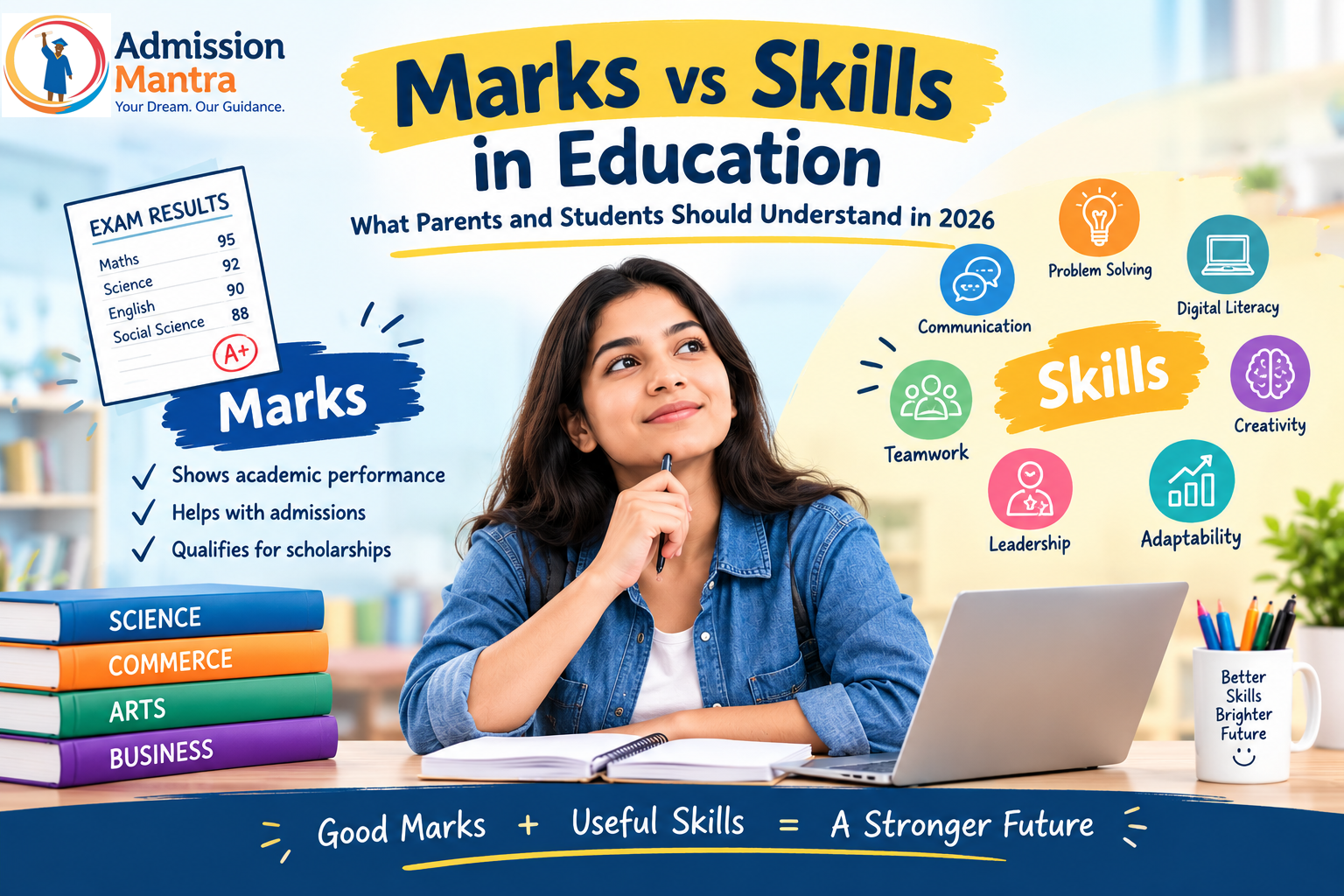
Marks vs Skills is an important question for Indian parents and students in 2026.
Marks vs Skills in Education is an important question for Indian parents and students in 2026.
For many years, marks were the main way to judge academic success. A high percentage could help students meet course eligibility, compete for admission, qualify for scholarships and build a strong academic record.
However, marks do not show everything.
A mark sheet cannot fully show communication, creativity, teamwork, practical problem-solving or digital skills. At the same time, skills cannot replace every degree or academic qualification.
Therefore, the real question is not:
“Marks or skills?”
Instead, parents should ask:
“How can students build strong academics and useful skills together?”
This guide explains what marks can show, what they cannot show, which skills students should develop and how parents can support children without creating unnecessary pressure.
Important: Marks still matter for many admissions, entrance routes, scholarships and academic requirements. The goal is not to ignore marks. Instead, students should build marks, skills, experience, confidence and career awareness together.
Why Are Marks So Important in India?
There are several reasons why marks became so important.
First, marks are easy to compare. A percentage gives schools, colleges and families a simple way to understand academic performance.
Second, many courses have minimum academic requirements. Depending on the programme, students may need certain subjects or minimum marks in Class 10, Class 12 or graduation.
Third, marks can matter for merit-based admission and scholarships.
As a result, parents should not tell children that marks are useless.
A better message is:
Marks matter, but they are only one part of a student’s development.
What Do Marks Measure?
Marks can provide useful information about academic learning.
They may show:
- Understanding of subjects
- Exam preparation
- Study habits
- Academic discipline
- Knowledge of the syllabus
- Ability to complete tests
- Performance under exam conditions
For example, a student who scores well in mathematics may have strong subject knowledge and good study habits.
However, that score does not automatically show whether the same student can explain a difficult idea, solve a new problem or use mathematics in a practical project.
That is where skills become important.
What Do Marks Not Fully Measure?
A mark sheet cannot fully show:
- Communication
- Creativity
- Teamwork
- Leadership
- Practical problem-solving
- Digital skills
- Curiosity
- Adaptability
- Project work
- Time management
- Portfolio quality
- Independent learning
Consider two students who receive similar marks.
One may be excellent at public speaking. Meanwhile, the other may be strong at coding or design.
Their marks may look similar. Their strengths, however, can be very different.
Therefore, parents should look beyond percentages when thinking about a child’s future.
Do Marks Still Matter in 2026?
Yes. They do.
This point is important because some discussions about skills go too far and suggest that marks no longer matter.
In reality, marks may be used for:
- College eligibility
- Entrance examination eligibility
- Merit-based admission
- Scholarships
- Subject choices
- Professional courses
- Academic progression
- Some government and institutional requirements
For that reason, students should continue to take academic study seriously.
At the same time, a strong mark sheet does not guarantee career success.
Once students enter college or work, they may also need communication, problem-solving, technical ability, internships and practical experience.
So, the goal should not be to reduce academic effort.
Instead, add useful skills to strong academic learning.
Marks vs Skills: The Real Difference
| Factor | Marks | Skills |
|---|---|---|
| Main purpose | Show academic performance | Show what a student can do |
| Usually measured by | Tests and exams | Practice, projects and real tasks |
| Useful for admission | Often important | Depends on course |
| Useful for work | Helpful | Often important |
| Shows subject knowledge | Yes | Sometimes |
| Shows communication | Limited | More directly |
| Shows practical ability | Limited | More directly |
| Can improve over time | Yes | Yes |
| Best use | Academic progress | Practical and career preparation |
These two areas should not be treated as competitors.
Marks can help students reach the next academic stage, while skills can help them use that opportunity well.
Marks vs Skills: Why Are Skills Getting More Attention in 2026?
The world of work is changing.
According to the World Economic Forum’s Future of Jobs Report 2025, employers expect skills such as AI and big data, networks and cybersecurity, technological literacy, creative thinking, resilience, flexibility, agility, curiosity and lifelong learning to become more important through 2030.
The report also says that 63% of employers surveyed see skills gaps as a major barrier to business transformation. In addition, nearly 40% of the skills required at work are expected to change by 2030.
These are global findings, not India-only placement figures. Even so, they show why students need the ability to keep learning.
The message for students is simple:
Do not stop learning when the exam ends.
What Is Happening in India’s Education System?
India is also moving towards more flexible and practical learning.
The latest completed AISHE data for 2022-23 recorded nearly 4.46 crore students in higher education, compared with 3.42 crore in 2014-15. The same data recorded 58,643 higher-education institutions.
That means students now have a very large range of courses and colleges to choose from.
At the same time, the National Education Policy 2020 supports vocational education, hands-on learning, internships and stronger links between education and work.
UGC has also introduced initiatives related to:
- Academic Bank of Credits
- Multiple Entry and Exit
- National Credit Framework
- Undergraduate curriculum reforms
- Multidisciplinary learning
As a result, students can get more ways to combine academic study with practical learning.
How Big Is the Skills Gap?
The India Skills Report 2026 reported overall employability at 56.35%. The report also gave different figures for different fields, including 80% for Computer Science, 78% for IT and 70.15% for BE/BTech.
However, these figures need to be understood correctly.
They do not mean that 56.35% of all graduates got jobs. Instead, the report uses its own assessment process to measure employability and skill readiness.
Therefore, students should treat these numbers as useful background information, not as placement guarantees.
The bigger lesson is this:
A degree provides a qualification. Skills help students show what they can do with that qualification.
Which Skills Should Students Build?
Not every student needs the same skills.
A software developer needs different skills from a doctor, lawyer, designer, teacher or accountant.
Still, several skills can help across many careers.
1. Communication Skills
Clear communication can help in college, interviews, internships and the workplace.
Students can practise:
- Speaking
- Writing
- Presentations
- Listening
- Asking questions
- Explaining ideas
2. Problem-Solving
Instead of only memorising an answer, students should learn how to find a solution.
For example, puzzles, experiments, projects, coding and real-life tasks can build this habit.
3. Digital Skills
Digital tools are now part of many careers.
Depending on the student’s interests, useful areas may include:
- Office tools
- Data tools
- Research tools
- AI tools
- Coding
- Design software
- Digital communication
4. Critical Thinking
Students should learn to ask:
Is this information correct?
What evidence supports it?
Are there other possible solutions?
This becomes even more important when students use social media and AI tools for learning.
5. Teamwork
College and workplace projects often involve other people.
Therefore, students should learn how to divide tasks, listen to others, accept feedback and complete their part of a project.
6. Adaptability
Technology and job roles can change quickly.
The World Economic Forum identifies resilience, flexibility, agility, curiosity and lifelong learning among skills expected to become more important.
For this reason, students should learn how to learn, not only what to learn.
Skills Students Can Build by Stream
Different streams can lead to different skill needs.
Science Students
Useful areas may include:
- Coding
- Data analysis
- Scientific writing
- Research
- Laboratory work
- Communication
- Presentation
Commerce Students
Useful areas may include:
- Excel
- Accounting software
- Financial analysis
- Data tools
- Power BI
- Communication
- Presentation
Arts and Humanities Students
Useful areas may include:
- Writing
- Research
- Communication
- Digital marketing
- Design
- Data presentation
- Content creation
Design Students
Useful areas can include:
- Design software
- UI/UX
- Visual communication
- Video editing
- Portfolio building
Business Students
Useful areas may include:
- Sales
- Marketing
- Analytics
- Communication
- Presentation
- Basic finance
- Project management
The key point is not to collect random certificates.
Instead, choose skills that match the career you want to explore.
Why Degree + Skills Can Be a Strong Combination
Students sometimes think they must choose between academic education and practical skills.
That is not always necessary.
In many cases, both can be developed together.
For example:
BCom + Excel + Accounting Software + Internship
BBA + Digital Marketing + Analytics + Project
BA English + Writing + SEO + Portfolio
BSc + Data Analysis + Research Project
BTech + Coding + Cloud + Internship
BDes + Design Software + Portfolio
The degree provides formal education.
Next, the skill helps the student perform useful work.
Then, the project or internship gives the student proof of that ability.
As a result, a student can graduate with both academic knowledge and practical experience.
Why Projects Matter
A good project answers an important question:
“What can this student actually do?”
For example:
A computer science student can build a small application.
A BCom student can create a financial dashboard.
A design student can build a portfolio.
An English student can create a writing collection.
A biology student can complete a research project.
A marketing student can prepare a sample campaign.
These projects do not need to be huge.
Instead, they should show effort, learning and practical use.
Why Internships Matter
An internship can help students understand how classroom knowledge is used at work.
During an internship, students may learn:
- Professional communication
- Teamwork
- Deadlines
- Workplace behaviour
- Industry tools
- Basic project work
- Reporting
- Problem-solving
However, not every internship gives useful experience.
Therefore, parents and students should ask:
- What work will the student actually do?
- Is the organisation genuine?
- How long is the internship?
- Is there a mentor?
- Is there a real project?
- Will the student receive feedback?
An internship certificate is not the main goal.
The learning experience is the goal.
What Parents Often Get Wrong About Marks
Parents usually care about marks because they want good opportunities for their children.
That concern is understandable.
Problems can start when marks become the only measure of success.
For example, a student may score 95% but still be unsure about the right career.
Another student may score 80% and show strong interest in coding, design, medicine, finance or business.
Neither situation should be judged only by the percentage.
Instead, parents should look at academic progress, interests, skills and career direction together.
Should Parents Stop Comparing Children?
Constant comparison can make children focus more on other people’s results than on their own progress.
Instead of saying:
“Your cousin scored more.”
try asking:
“Did you improve?”
Instead of saying:
“Your friend got a better rank.”
ask:
“Which subject would you like help with?”
Likewise, replace:
“Why can’t you be like that student?”
with:
“What can we do to help you improve?”
This creates a more useful conversation.
What About Academic Pressure and Student Well-Being?
Academic pressure should be handled carefully.
Studying for exams is normal. Wanting good marks is normal too.
However, students also need sleep, rest, exercise, social connection and emotional support.
WHO says that one in seven people aged 10–19 globally experiences a mental health condition. WHO also highlights the importance of supportive environments and healthy coping skills for adolescents.
These are global figures, not India-specific school statistics.
Even so, parents should pay attention when a child shows ongoing changes in mood, sleep, school attendance or daily functioning.
In serious cases, professional support should be considered.
What Can Parents Do Differently in 2026?
Keep academic goals realistic
Encourage good study habits without making one exam the measure of a child’s worth.
Encourage skill exposure
Students can try:
- Projects
- Sports
- Competitions
- Coding
- Art
- Writing
- Public speaking
- Research
- Volunteering
- Internships when appropriate
Allow safe failure
Small mistakes can become useful learning experiences.
When students get a chance to try, fail, improve and try again, they can build confidence.
Talk about careers early
Career awareness does not mean forcing a child to choose one career at age 13.
Instead, expose students to different careers and let them ask questions.
Focus on progress
Compare the child’s current performance with their earlier performance.
That gives a much better picture than comparing them with another child.
What Should Students Do Alongside Their Studies?
A balanced routine can include:
Academic study: Learn school or college subjects properly.
Skill learning: Choose one useful skill at a time.
Project time: Apply the skill to something practical.
Reading: Learn about careers and industries.
Activities: Take part in sports, clubs or creative work.
Rest: Get enough sleep and regular breaks.
The purpose is not to keep children busy every minute.
Instead, the goal is to build a healthy mix of academic learning and life experience.
Which Skills Should Students Build After Class 10 or 12?
The answer depends on the stream and career goal.
Science
Consider:
- Coding
- Data analysis
- Research
- Laboratory skills
- Scientific communication
Commerce
Consider:
- Excel
- Accounting software
- Financial analysis
- Data tools
- Presentation skills
Arts
Consider:
- Writing
- Research
- Communication
- Digital marketing
- Design
- Data presentation
Design
Consider:
- Design software
- UI/UX
- Video editing
- Portfolio building
Business
Consider:
- Sales
- Marketing
- Analytics
- Communication
- Presentation
- Basic finance
A random collection of certificates is not the goal.
Instead, select skills that support the career you want.
What Employers May Look For in Future Graduates
The exact requirements depend on the industry and job.
However, the World Economic Forum’s 2025 employer survey highlights a mix of technology and human skills. AI and big data, cybersecurity, technological literacy, creative thinking, resilience, flexibility, curiosity and analytical thinking are among the skills expected to grow in importance.
This means students should not focus on one technical tool alone.
For example, learning an AI tool can be useful.
At the same time, knowing how to think, communicate and solve problems remains important.
A balanced skill set can therefore be more useful than one narrow skill.
Marks vs Skills: Does One Matter More?
Not exactly.
That statement is too simple.
Marks and skills serve different purposes.
Marks can help students qualify for courses, scholarships and academic opportunities.
Skills can help students apply knowledge, work with others and solve practical problems.
Therefore, a better question is:
“What is the student’s academic level, and what can the student do beyond the mark sheet?”
For many students, both answers matter.
Career Guidance Can Help Students
Students sometimes choose courses because of:
- Family pressure
- Friends
- Social media
- Salary claims
- Popular careers
- College advertising
Career guidance can provide another way to look at the decision.
The OECD’s career-guidance research highlights the value of helping young people explore careers and understand the world of work.
In addition, career exploration can help students compare different paths before making a major education decision.
The research is international, so it should not be treated as a guarantee for every Indian student.
Still, one lesson is clear:
Career decisions should be informed decisions, not pressure decisions.
What Can Parents Do From Class 8 to College?
Parents do not need to wait until Class 12.
Class 8–10
Focus on:
- Strong basics
- Reading
- Communication
- Sports
- Creative activities
- Digital awareness
- Curiosity
Class 10–12
Start exploring:
- Career options
- Courses
- Entrance routes
- Colleges
- Skills
- Short projects
- Competitions
College
Gradually add:
- Internships
- Projects
- Industry exposure
- Communication
- Portfolio building
- Career guidance
- Professional networking
This gradual approach can be easier than waiting until graduation to start career planning.
What If a Student Has Low Marks?
First, do not panic.
Instead, find out why the marks are low.
Possible reasons include:
- Weak subject basics
- Poor study habits
- Lack of practice
- Exam fear
- Time-management problems
- Lack of interest
- Personal difficulties
- An unsuitable study method
Once the reason is clear, the next step becomes easier.
The student may need better study support, more practice, a new learning method or help with a specific subject.
Meanwhile, remember that one exam does not define an entire career.
What If a Student Has Very High Marks?
High marks are a real achievement.
They should be appreciated.
However, academic success does not automatically solve the career decision.
The student should still explore:
- Interests
- Courses
- Careers
- Skills
- Colleges
- Entrance routes
- Higher-study options
A student with 95% can still benefit from career guidance.
Does Every Student Need Coding?
No.
Coding is useful for many technology careers. However, it is not required for every profession.
A future doctor needs medical knowledge and clinical training.
A lawyer needs legal knowledge, research and communication.
A designer needs design skills and a portfolio.
A teacher needs subject knowledge, teaching ability and communication.
An accountant may need finance skills and accounting software.
Therefore, choose skills according to the career.
Marks vs Skills: Common Myths
Myth 1: High marks guarantee career success
Not necessarily.
Marks can help with academic entry, but career outcomes also depend on skills, course choice, experience and the job market.
Myth 2: Average marks mean a weak future
Not at all.
Students can improve their skills, choose a suitable course, gain experience and keep learning.
Myth 3: Skills are more important, so marks do not matter
This is also incorrect.
Many courses still have academic eligibility requirements.
The better approach is:
Good Academics + Useful Skills
Myth 4: Every student needs coding
No.
Different careers need different skills.
Myth 5: Certificates prove that a student has skills
Not always.
A certificate shows that a course was completed. A project, portfolio or internship can show how the student uses the skill.
What Should Parents Ask Instead of Only “How Many Marks?”
Try questions such as:
Which new idea caught your attention today?
Where did you face a challenge?
Which activity did you enjoy the most?
What would you like to explore next?
Which career sounds interesting?
Would you like to try a project?
What help do you need from us?
These questions can help parents understand the child, not just the result.
A Simple Marks + Skills Scorecard for Parents
Parents can review these areas every few months.
| Area | Question |
|---|---|
| Academics | Is the child understanding the subjects? |
| Communication | Can the child explain ideas clearly? |
| Skills | Is the child learning something useful? |
| Practical work | Has the child completed a project? |
| Curiosity | Does the child ask questions? |
| Confidence | Can the child handle mistakes? |
| Teamwork | Can the child work with others? |
| Career awareness | Does the child know different career options? |
| Well-being | Is the child getting enough rest and support? |
| Progress | Is the child improving over time? |
This creates a wider picture than looking only at marks.
Marks vs Skills: The Right Goal for 2026
The goal should not be:
100% Marks
It should also not be:
100% Skills
A more balanced goal is:
Strong Academics + Useful Skills + Practical Experience + Career Awareness + Healthy Support
Each part has a purpose.
Marks
They support academic eligibility and progression.
Skills
They help students apply knowledge.
Experience
It gives students a better idea of real work.
Career awareness
It helps students choose courses more carefully.
Healthy support
It gives students space to learn without constant fear.
Final Checklist for Parents
Before pushing a child toward a particular course or career, ask:
- Does my child understand the basic subjects?
- What does my child enjoy learning?
- Which skills are developing?
- Has my child tried practical projects?
- Does my child know different career options?
- Is the course choice based on interest and ability?
- Are marks being treated as one part of the picture?
- Are we comparing the child too much with others?
- Is my child getting enough sleep and rest?
- Have we discussed more than one career path?
The answers can help parents create a better education plan.
Related Articles From Admission Mantra
Best Courses After 12th in India
Explore courses across Science, Commerce and Arts, including fees, duration, career scope and admission routes.
Read: Best Courses After 12th in India
How to Choose the Right College After 12th
Learn how to compare college recognition, fees, placements, internships, hostel costs and admission rules.
Read: How to Choose the Right College After 12th
Skill-Based vs Traditional Degrees
Understand how academic education, practical skills, internships and industry exposure can work together.
Read: Skill-Based vs Traditional Degrees
Courses Without NEET in India
Explore healthcare and allied-health options for students considering careers beyond MBBS.
Read: 10 Courses Without NEET in India
Admission Mantra Blog
Explore more guides on courses, admissions, NEET, engineering and career planning.
Read: Admission Mantra Blog
Useful Official Resources for Parents and Students
World Economic Forum – Future of Jobs
The World Economic Forum’s Future of Jobs Report 2025 explains how AI, big data, cybersecurity, technological literacy, creative thinking, resilience and lifelong learning are expected to shape future skill needs.
Official resource: World Economic Forum – Future of Jobs Report
University Grants Commission – Higher Education Initiatives
UGC provides official information about initiatives such as the Academic Bank of Credits, Multiple Entry and Exit, undergraduate curriculum frameworks and multidisciplinary education.
Official resource: UGC – Major Initiatives
OECD – Career Guidance
The OECD provides research on career guidance and highlights the value of helping young people explore careers and gain first-hand experience of the world of work.
Official resource: OECD – Career Guidance
WHO – Adolescent Mental Health
WHO provides information for parents, schools and communities on adolescent mental health, including the importance of supportive environments, coping skills, problem-solving and healthy habits.
Official resource: WHO – Adolescent Mental Health
Frequently Asked Questions
Are marks still important in 2026?
Yes. Marks can matter for course eligibility, admission, scholarships, entrance routes and other academic requirements.
Are skills more important than marks?
It is better not to treat them as competitors. Marks support academic progress, while skills help students apply knowledge and prepare for practical work.
Can an average student build a good career?
Yes. Marks are only one part of a student’s journey. Course choice, skills, experience, communication and continuous learning also matter.
Should parents stop asking about marks?
No. Parents should still monitor academic progress. However, they should also ask about learning, skills, projects, confidence and career interests.
Which skills should every student learn?
Communication, problem-solving, digital literacy and the ability to keep learning are useful across many careers. After that, students should add field-specific skills.
Does every student need coding?
No. Coding is important for many technology careers, but other professions need different skills.
Are certificates enough?
Not always. A certificate can show that a student completed a course. Projects, portfolios and internships can provide stronger evidence of practical ability.
Can marks affect college admission?
Yes. Many courses and colleges have academic eligibility requirements. The exact rules depend on the course and institution.
How can parents reduce unnecessary academic pressure?
Parents can set realistic goals, avoid constant comparisons, focus on learning and improvement, allow rest and seek appropriate professional help when a child shows persistent or serious distress.
When should career planning begin?
Career awareness can start before Class 12. However, students do not need to make one final career decision at a very young age.
Final Conclusion: Marks Open Doors, Skills Help Students Move Forward
The discussion around Marks vs Skills in Education should not become another competition.
Marks matter because they can help students meet academic requirements and move to the next stage of education.
At the same time, skills matter because students eventually need to communicate, solve problems, use technology, work with others and keep learning.
Therefore, a useful goal is:
Good Marks + Useful Skills + Practical Experience + Career Awareness + Healthy Support
Parents do not have to choose between academic achievement and practical growth.
Instead, help children build both.
A mark sheet shows part of what a student has learned. A project, skill or internship can show how that student uses the knowledge.
In the end, the aim is not simply to raise a topper.
The aim is to help a student become a capable learner who can understand, apply, adapt and grow.
Need Help With Course and Career Planning?
Admission Mantra helps students and parents compare courses, colleges, eligibility, fees, admission routes and career options before making an important education decision.
Admission Mantra Pvt Ltd
Sanjaynagar, Bangalore
Sharpen your future. Make your admission decision with the right information.