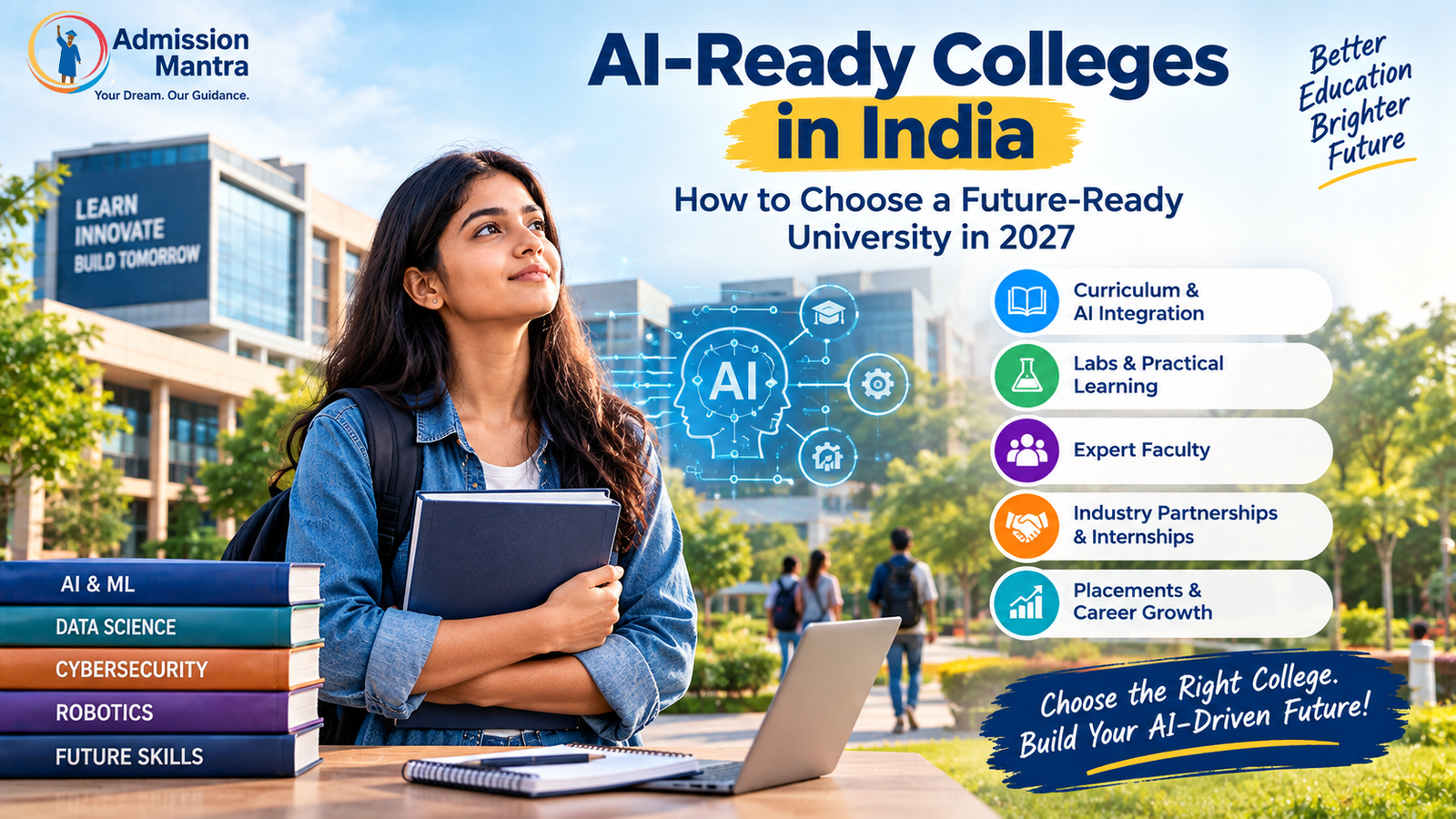
AI-Ready Colleges in India: How to Choose a Future-Ready University in 2027
AI-ready colleges in India are becoming an important consideration for students choosing higher education. But what actually makes a college “AI-ready”? Is a B.Tech in Artificial Intelligence enough? Does having an AI lab guarantee better career opportunities? And how can parents identify whether a college is genuinely preparing students for the changing job market?
These questions matter because Artificial Intelligence is no longer limited to computer science.
AI is influencing healthcare, finance, engineering, education, design, law, marketing, manufacturing, research and many other fields.
At the same time, Indian higher education is changing.
In August 2026, the Government of India stated that AI, Data Science, Machine Learning, Cybersecurity, Robotics and Quantum Computing are being integrated into revised technical curricula through AICTE initiatives. The government also highlighted the need for experiential, inquiry-driven and learner-centred education under NEP 2020. Read the Ministry of Education announcement on emerging technologies in higher education.
Earlier in May 2026, the Ministry of Electronics & IT also announced work on an overhaul of AI curriculum with industry participation, with emphasis on practical exposure, industry-integrated learning, faculty development and shared infrastructure. Read the official AI curriculum update.
Therefore, students choosing a college for 2027 and beyond need to think beyond the name of the degree.
The real question is:
Can this college help me build the knowledge, skills and experience I will need in an AI-driven economy?
What Is an AI-Ready College?
An AI-ready college is not simply an institution that offers a course called Artificial Intelligence.
Instead, a future-ready institution should ideally help students understand how AI and emerging technologies affect their particular field.
For example:
Computer Science + AI
can lead toward software, machine learning, data and automation.
Commerce + AI
can lead toward financial analytics, automation and business intelligence.
Medicine + AI
can expose students to healthcare technology, medical data and AI-assisted systems.
Management + AI
can support careers in business analytics, marketing technology and operations.
Design + AI
can involve generative design, user experience and digital production.
Therefore, the real value comes from the combination:
Degree + Domain Knowledge + AI Literacy + Practical Skills + Experience
That is why parents should not select a college solely because its brochure contains the word “AI”.
Why Are AI-Ready Colleges Becoming Important in India?
The higher-education environment is entering a period of rapid transformation.
The QS India Summit 2026 brought together higher-education leaders, policymakers, industry executives and international partners around the theme of building skills, achieving scale and driving innovation. Its report identified several priorities for Indian institutions, including connecting education more closely with employment, integrating AI into teaching and institutional operations, strengthening research and expanding international collaboration. Read the QS India Summit 2026 Report.
The Government of India is also pushing curriculum updates and digital infrastructure to prepare students for emerging technologies. See the Ministry of Education’s 2026 announcement.
Meanwhile, the labour market is becoming more skills-focused.
The OECD’s 2026 report A Skills-First Labour Market says labour markets are undergoing rapid transformation and that the gap between employer skill requirements and what formal education alone can provide is widening. Read the OECD report.
The World Economic Forum’s Future of Jobs Report 2025 also identifies AI and big data, networks and cybersecurity, and technological literacy among the fastest-growing skills through 2030. At the same time, analytical thinking, creative thinking, resilience, flexibility and leadership remain important. Read the WEF Future of Jobs Report.
So, the future-ready college is not just about technology.
It is about preparing students to work effectively with technology.
AI-Ready College vs AI Degree: What Is the Difference?
This distinction is extremely important.
A college can offer:
B.Tech Artificial Intelligence
without necessarily providing a strong overall learning experience.
Conversely, a university may not offer a degree specifically called AI but may integrate AI tools, analytics and emerging technologies into several programmes.
For example:
| Programme | Possible AI Integration |
|---|---|
| B.Tech CSE | Machine learning, AI, data, automation |
| B.Com | Financial analytics, automation, AI-assisted business tools |
| BBA | Business analytics, marketing technology, AI applications |
| B.Sc | Data analysis, computational research |
| BA | AI-assisted research, communication and digital tools |
| B.Des | Generative design, UX tools, digital workflows |
| Healthcare | Medical data, health technology and AI applications |
Therefore, don’t ask only:
“Does this college offer an AI course?”
Instead ask:
“How does this college prepare students for an AI-enabled world?”
10 Things to Check Before Choosing an AI-Ready College
Choosing among AI-ready colleges in India becomes much easier when parents use a practical checklist.
1. Check Whether the Institution Is Properly Recognised
Before looking at AI labs, placements or technology, verify the institution and qualification.
Students should check:
- University status
- Recognition
- Programme approval where applicable
- Accreditation where relevant
- Degree-awarding authority
- Professional recognition for regulated fields
The University Grants Commission’s official regulations provide important information on higher-education regulations and standards.
This step should come first because an advanced-looking course is of limited value if the underlying qualification does not meet the requirements of your intended career.
2. Examine the Actual Curriculum
Never choose a college simply because its website says:
AI Ready
Future Ready
Industry Ready
AI Powered
These are promotional terms.
Instead, download the actual syllabus.
Then check:
- What subjects are taught?
- How recently was the curriculum updated?
- Which programming or analytical tools are included?
- Is data literacy included?
- Are practical assignments part of the course?
- Are AI applications taught responsibly?
- Are students exposed to real-world problems?
The Government’s 2026 higher-education update specifically notes the integration of AI, Data Science, Machine Learning, Cybersecurity, Robotics and Quantum Computing into revised technical curricula. Read the official announcement.
Therefore, the syllabus should be one of the first documents a parent requests.
3. Find Out How Much Practical Learning Students Actually Get
A modern curriculum is useful.
However, students also need opportunities to apply what they learn.
Ask whether the college provides:
- Projects
- Labs
- Hackathons
- Simulations
- Industry assignments
- Internships
- Case studies
- Research projects
- Capstone projects
For example, a student studying AI should ideally have opportunities to build or analyse something rather than only memorise theory.
A college that provides ten AI subjects but very little practical work may not be as useful as a college that provides fewer specialised subjects but stronger hands-on learning.
4. Look at the Faculty, Not Just the Infrastructure
Many colleges promote:
- AI labs
- Smart classrooms
- Supercomputers
- Modern campuses
- Robotics centres
These facilities can be useful.
Nevertheless, good infrastructure does not automatically create good education.
Students should also examine faculty strength.
Ask:
- Do faculty members have relevant expertise?
- Are faculty involved in research?
- Have they worked on AI or industry projects?
- Are students encouraged to participate in research?
- Does the college organise technical workshops?
- Are industry experts invited?
Strong faculty can make technology facilities much more valuable.
5. Check Industry Partnerships
One of the most important differences between a theory-heavy course and a future-ready course is industry exposure.
Look for evidence of:
- Industry partnerships
- Live projects
- Internships
- Guest lectures
- Mentorship
- Industry visits
- Apprenticeships
- Joint research
- Placement partnerships
However, be careful with generic statements such as:
“100+ industry partners.”
Ask for specifics.
Which companies?
For which programme?
What do students actually receive?
Are students getting internships, projects or only attending occasional seminars?
A genuine industry relationship should create meaningful opportunities.
6. Check Internship Opportunities
An AI-ready college should help students build practical experience.
Internships can help students understand:
- How AI is used in real companies
- How teams work
- How projects are managed
- How data is handled
- How business problems are defined
- How technology is tested
- How professionals communicate
Students should therefore ask:
Is the internship compulsory, recommended or merely advertised?
That difference matters.
A college brochure may mention internships without explaining whether students actually obtain them.
7. Examine Research and Innovation Opportunities
AI is not only a job skill.
It is also a major research area.
Students who are interested in deeper academic careers should look for:
- Research centres
- AI laboratories
- Faculty research
- Publications
- Patents
- Student research projects
- Innovation competitions
- Startup incubation
- International research collaboration
The QS India Summit 2026 report emphasised research impact, innovation, industry connections and international collaboration as important components of India’s higher-education transformation. Explore the QS report.
Therefore, students planning a master’s degree, PhD or research-oriented career should treat research exposure as an important selection factor.
8. Look Beyond Computer Science
This may be one of the most important lessons for parents.
AI is no longer only a computer-science topic.
A strong future-ready college should help students understand how AI connects with their chosen subject.
Commerce Students
AI can support:
- Financial analysis
- Automation
- Fraud detection
- Business intelligence
- Forecasting
Management Students
AI can support:
- Marketing analytics
- Customer analysis
- Business forecasting
- Operations
- Decision support
Science Students
AI can support:
- Research
- Data analysis
- Modelling
- Scientific computing
- Pattern recognition
Design Students
AI can support:
- Ideation
- Visual exploration
- UX workflows
- Prototyping
- Digital production
Healthcare Students
AI can be relevant to:
- Medical imaging
- Healthcare analytics
- Digital health
- Clinical decision support
- Hospital technology
Students interested in broader career options after Class 12 can also explore Admission Mantra’s Best Courses After 12th in India: Career Options, Fees & Scope.
9. Check How the College Uses AI in Teaching and Learning
A future-ready college should not only teach AI.
It should also consider how AI can improve learning.
For example, institutions may explore:
- AI-assisted learning
- Personalised learning tools
- Digital assessments
- Simulation-based education
- Research support
- Academic analytics
- Student support systems
The Government of India announced an AI-enabled state university pilot at Chaudhary Charan Singh University, Meerut, in January 2026 as part of a broader vision for AI-enabled education and skilling. Read the official announcement.
This reflects a wider movement toward integrating AI into the educational process itself.
10. Check Whether the College Teaches Responsible AI Use
Learning AI is not only about tools.
Students also need to understand:
- Accuracy
- Bias
- Data privacy
- Copyright
- Academic integrity
- Cybersecurity
- Ethical decision-making
- Human oversight
This is especially important because students will increasingly use generative AI for writing, research, coding, design and analysis.
A future-ready college should therefore encourage students to use AI responsibly rather than simply use it everywhere.
The goal should be:
AI-assisted learning, not AI-dependent learning.
A Simple AI-Ready College Scorecard
Parents can use the following scoring method when comparing colleges.
| Area | Score |
|---|---|
| Recognition & accreditation | /10 |
| Curriculum relevance | /10 |
| AI exposure | /10 |
| Faculty expertise | /10 |
| Practical learning | /10 |
| Industry partnerships | /10 |
| Internship opportunities | /10 |
| Research & innovation | /10 |
| Placement outcomes | /10 |
| Total education value | /10 |
The purpose is not to create a universal college ranking.
Instead, it helps a family compare College A vs College B using the same criteria.
Does an AI Degree Guarantee a High-Paying Job?
No.
This is an important point.
The popularity of AI has encouraged many institutions to launch programmes with names such as:
- Artificial Intelligence
- Artificial Intelligence & Machine Learning
- Data Science
- AI & Data Analytics
- Generative AI
- Robotics
- Intelligent Computing
But a course title does not guarantee employability.
A student’s career outcome can depend on:
- College quality
- Curriculum
- Technical ability
- Projects
- Internship
- Communication
- Interview performance
- Industry demand
- Location
- Experience
- Continuous learning
The OECD’s 2026 research reinforces this wider skills-first approach, noting that formal education alone may not fully match changing employer requirements. Read the OECD report.
So, parents should be careful about any institution promising:
“AI degree = guaranteed high salary.”
There is no such universal formula.
AI-Ready College vs Marketing-Ready College
This is a useful way to think about admission decisions.
A genuinely future-ready college may show:
- Updated syllabus
- Practical labs
- Skilled faculty
- Industry projects
- Internship opportunities
- Research
- Transparent placement data
- AI exposure across disciplines
- Responsible AI education
A marketing-focused college may mainly show:
- AI written across advertisements
- Expensive technology displays
- “Future-proof” claims
- Very high package figures
- Unclear industry partnerships
- No detailed syllabus
- No transparent internship information
The difference becomes clear when you ask for evidence.
What Parents Should Ask During a College Visit
Before paying the admission fee, parents can ask the following questions.
Curriculum
“Can we see the latest syllabus?”
AI Exposure
“Which AI tools or subjects are taught in this programme?”
Practical Learning
“How many projects will students complete?”
Internship
“Is the internship compulsory, and who helps students obtain it?”
Faculty
“How many faculty members actively work in this area?”
Industry
“Which companies provide live projects or internships?”
Research
“Can undergraduate students participate in research?”
Placement
“Can we see programme-specific placement data rather than only the highest package?”
Fees
“What is the complete cost including hostel, technology, examination and other charges?”
Higher Studies
“What options are available after graduation?”
These questions can reveal more than a campus tour.
What Should Students Learn Alongside Their Degree?
Even the best college cannot build an entire career for a student.
Students should also develop their own skills.
Core Skills
- Communication
- Problem-solving
- Analytical thinking
- Teamwork
- Presentation
- Research
Digital Skills
Depending on the field:
- AI literacy
- Data analysis
- Excel
- Coding
- Cloud basics
- Digital tools
- Cybersecurity awareness
Career Skills
- Resume writing
- Interview preparation
- Networking
- Portfolio building
- Internship experience
Admission Mantra’s Marks vs Skills: What Parents Must Understand explains why academic marks should be developed alongside broader career skills.
Similarly, Skill-Based Degrees vs Traditional Degrees in India 2026 explains why students often benefit from combining a recognised degree with practical skills and experience.
Why Human Skills Still Matter in an AI-Driven World
An AI-ready college should not become an AI-only college.
Technology can analyse information quickly.
However, people still need to:
- Ask the right questions
- Understand context
- Make ethical decisions
- Communicate
- Lead teams
- Work with clients
- Understand people
- Take responsibility
The World Economic Forum’s Future of Jobs Report 2025 highlights analytical thinking, creative thinking, resilience, flexibility and leadership alongside technology-related skills. Read the WEF report.
Consequently, the strongest students of the future may not be those who simply know the most AI tools.
They may be the students who combine:
Domain Knowledge + AI Literacy + Human Judgment
What About Engineering Students?
Engineering remains one of the major areas where AI and emerging technologies are being integrated.
Students can explore fields such as:
- Computer Science
- Artificial Intelligence
- Data Science
- Cybersecurity
- Electronics
- VLSI
- Robotics
- Mechatronics
- Cloud Computing
- Semiconductor Technology
However, students should not choose an engineering branch solely because it contains the word “AI”.
The fundamentals still matter.
A strong programme can combine:
Programming + Mathematics + Data Structures + Systems + AI + Projects + Internship
Students considering engineering options can read Admission Mantra’s Best Engineering Courses in India: BTech or BE Scope 2027–2030.
What About Students Who Do Not Want Engineering?
An AI-driven future does not mean every student should become an engineer.
That would create another kind of career-selection problem.
Students can also explore:
Commerce
Finance + Data + AI
Management
Business + Analytics + AI
Science
Research + Data + AI
Design
Design + AI + UX
Law
Legal Knowledge + Technology
Healthcare
Healthcare + Data + Digital Health
Media
Communication + AI + Digital Content
Students who do not want to pursue NEET or JEE can explore other pathways through Admission Mantra’s What to Do After 12th Without NEET & JEE in 2026.
For healthcare-focused students, Courses Without NEET in India: 10 Healthcare Careers to Explore in 2026 explains alternative healthcare pathways.
How to Identify a Future-Ready Curriculum
A future-ready curriculum should develop strong fundamentals before moving into advanced technologies. Therefore, parents should compare what students will actually learn rather than choosing a college simply because its course includes the word “AI”.
For example, consider these two approaches:
College A: AI-Focused but Limited Foundation
- Introduction to AI
- AI Seminar
- AI Workshop
- AI Certification
This structure may introduce students to AI concepts, but it provides limited information about the underlying knowledge and practical abilities they will develop.
College B: Strong Foundation + AI + Practical Experience
- Programming
- Data Structures
- Statistics
- Database Systems
- Machine Learning
- Artificial Intelligence
- Data Analytics
- Real-world Projects
- Internship
- Capstone Project
By comparison, College B offers a broader learning pathway. Students first develop programming, mathematics, statistics and data fundamentals. Later, they can apply those foundations through machine learning, AI, projects and internships.
As a result, the second approach can provide a stronger foundation for long-term learning and career development.
A good AI curriculum should build strong fundamentals first, then combine advanced technology with practical projects and real-world experience.
Should Students Choose a Specialised AI Degree or a Broader Degree?
There is no universal answer.
A Specialised AI Degree May Suit Students Who:
- Already have strong interest in technology
- Enjoy mathematics and programming
- Want a technical career
- Are comfortable specialising early
A Broader Degree May Suit Students Who:
- Are still exploring career options
- Want multidisciplinary flexibility
- Prefer combining domain knowledge with technology
- May later specialise through postgraduate study
For example:
BSc + Data Science Skills
or:
BCom + Analytics
can be useful combinations depending on the career.
The choice should reflect the student’s interests, ability and long-term goal.
What About Fees?
Parents should remember that an AI-branded programme may cost more.
However, higher fees do not automatically mean better education.
When comparing colleges, calculate the total cost of education:
- Tuition
- Hostel
- Food
- Travel
- Laptop or equipment
- Examination charges
- Books
- Certifications
- Other institutional fees
Then compare that cost with:
- Course quality
- Practical exposure
- Internship
- Placement outcomes
- Faculty
- Research
- Alumni outcomes
A lower-cost programme with excellent practical training may be better value than a very expensive course with limited exposure.
For a complete college-selection framework, read How to Choose the Right College After 12th in India: 2027 Guide.
Red Flags When Choosing an AI-Ready College
Parents should be cautious when an institution:
Promises a Guaranteed AI Career
No college can guarantee a specific salary or job simply because a student studies AI.
Uses AI as a Marketing Keyword Everywhere
A brochure filled with “AI” does not prove that the curriculum is strong.
Cannot Show the Detailed Syllabus
Students should be able to see what they will actually study.
Cannot Explain Internship Opportunities
A vague internship promise should not be treated as strong industry exposure.
Shows Only the Highest Salary
One large package does not represent the entire graduating class.
Does Not Explain Recognition
Students should know exactly who awards the degree and what recognition applies.
Provides Expensive Certifications Without Clear Career Value
A certificate is not automatically valuable because it has a technology-related name.
A 5-Minute AI-Ready College Test
Before admission, ask these five questions:
Question 1
Can the college show the latest syllabus?
Question 2
Can students work on real projects?
Question 3
Are internships and industry interactions available?
Question 4
Can the institution show transparent placement outcomes?
Question 5
Will the student develop both technical and human skills?
If the answers are clear and supported by evidence, the college deserves a closer look.
If the answers are vague, continue comparing.
How Students Can Become AI-Ready Even Without an AI Degree
A student does not need to study Artificial Intelligence as the name of the degree.
Instead, students can develop basic AI literacy during college.
For Commerce Students
Learn:
- Excel
- Data analysis
- AI-assisted research
- Financial technology
For Management Students
Learn:
- Analytics
- Digital marketing
- Business intelligence
- AI tools
For Science Students
Learn:
- Statistics
- Data analysis
- Research tools
- Computational methods
For Design Students
Learn:
- Digital design
- AI-assisted workflows
- UX tools
- Portfolio development
For Arts Students
Learn:
- Research
- Writing
- Digital communication
- AI-assisted productivity
The important point is to use AI as a tool while preserving human judgment.
A Practical College Selection Checklist for Parents
Before paying the admission fee, use this checklist.
Institution
☐ Recognised institution
☐ Appropriate programme approval
☐ Clear degree-awarding authority
☐ Transparent academic information
Curriculum
☐ Updated syllabus
☐ Strong fundamentals
☐ AI/emerging technology exposure
☐ Practical subjects
☐ Project-based learning
Faculty
☐ Relevant expertise
☐ Research activity
☐ Industry exposure
☐ Student mentoring
Practical Learning
☐ Laboratories
☐ Projects
☐ Internships
☐ Industry interaction
☐ Capstone work
Career Preparation
☐ Placement information
☐ Career counselling
☐ Interview preparation
☐ Portfolio development
☐ Higher-study guidance
Cost
☐ Tuition fee
☐ Hostel and living costs
☐ Technology expenses
☐ Other compulsory charges
☐ Scholarship information
Long-Term Value
☐ Higher-study options
☐ Industry relevance
☐ International opportunities
☐ Transferability or mobility where applicable
☐ Scope for continuous learning
Frequently Asked Questions
What is an AI-ready college?
An AI-ready college is an institution that prepares students to understand and use artificial intelligence and related technologies appropriately within their field. It should ideally combine relevant curriculum, practical exposure, faculty expertise, industry interaction and career preparation.
Is an AI degree necessary for an AI career?
Not always. Some technical AI careers require strong computing, mathematics and data skills, while other careers may involve AI as part of a broader domain such as finance, healthcare, management, design or marketing.
Which course is best for AI careers?
There is no single best course for every student. Depending on your background and goals, options can include Computer Science, Artificial Intelligence, Data Science, Mathematics, Statistics, Electronics and other technology-related programmes.
Should every student study AI?
Students do not necessarily need advanced AI engineering skills. However, basic AI literacy is becoming useful across many fields because technology is increasingly integrated into education and employment.
How do I know whether a college’s AI programme is genuine?
Check the university recognition, syllabus, faculty expertise, laboratories, projects, internships, industry partnerships, research opportunities and transparent placement information.
Does an AI-ready college guarantee a high-paying job?
No. Career outcomes depend on the student’s skills, projects, internship experience, communication, college quality, industry demand and other factors.
Is B.Tech AI better than B.Tech Computer Science?
Not automatically. A broader Computer Science programme can provide strong fundamentals and allow later specialisation, while a specialised AI programme may suit students who already know they want to focus on AI. Compare the actual syllabus rather than only the degree title.
Can Commerce or Arts students benefit from AI?
Yes. AI is increasingly relevant to finance, business analytics, marketing, communication, research, design and other non-engineering areas.
What should parents ask during a college visit?
Parents should ask about syllabus updates, AI exposure, practical projects, internships, faculty expertise, industry partnerships, placement data, total fees and higher-study opportunities.
Is an AI lab enough to call a college future-ready?
No. An AI lab is only one component. The quality of the curriculum, faculty, practical training, research, industry exposure and student outcomes matter as well.
Final Takeaway: Choose a Future-Ready College, Not Just a Trendy Course
The rise of AI-ready colleges in India reflects a much bigger change in higher education.
Students are no longer choosing colleges only for a degree certificate.
Increasingly, they are looking for:
Relevant knowledge
Practical skills
Industry exposure
Research
Technology
Internships
Employability
Global opportunities
The good news is that students do not have to choose an AI-branded degree simply because AI is trending.
Instead, they should choose a strong education pathway and understand how AI can complement their chosen field.
A future-ready education could look like:
Recognised Degree + Strong Fundamentals + AI Literacy + Practical Projects + Internship + Communication + Continuous Learning
That combination can be more valuable than simply choosing a course because the word “AI” appears in its title.
The Government of India is already pushing the integration of AI and other emerging technologies into technical curricula, while the higher-education sector is also focusing on stronger links between skills, employment, research and innovation. Read the Ministry of Education’s 2026 update.
At the same time, the global job market is changing quickly. The WEF and OECD both highlight the growing importance of technical and human skills as education and employment evolve. WEF Future of Jobs Report | OECD Skills-First Labour Market.
Therefore, the question for parents should not be:
“Does this college have AI?”
Instead, ask:
“Will this college prepare my child to learn, adapt and work effectively in an AI-driven world?”
That is the more important question.
And before paying the admission fee, compare:
Recognition + Curriculum + Faculty + Practical Learning + Industry Exposure + Research + Placements + Cost + Future Relevance
A college does not become future-ready because of one laboratory, one certificate or one attractive advertisement.
The entire learning ecosystem matters.
For students entering higher education in 2027, choosing the right college today can influence not only the degree they earn, but also the skills, confidence and opportunities they carry into the next decade.
Related Admission Mantra Guides
Students and parents can continue their research through these Admission Mantra resources:
How to Choose the Right College After 12th in India: 2027 Guide
Best Courses After 12th in India: Career Options, Fees & Scope
Skill-Based Degrees vs Traditional Degrees in India 2026
Marks vs Skills: What Parents Must Understand
Careers in India Less Likely to Be Replaced by AI: 2026 Guide
Best Engineering Courses in India: BTech or BE Scope 2027–2030
What to Do After 12th Without NEET & JEE in 2026
Courses Without NEET in India: 10 Healthcare Careers to Explore in 2026
Trusted Official & Research Sources
Ministry of Education, Government of India — Emerging Technologies in Higher Education
Government of India — AI Curriculum Revamp and Industry Integration
Government of India — AI-Enabled State University Pilot
University Grants Commission — Regulations
National Institutional Ranking Framework — Official Information
World Economic Forum — Future of Jobs Report 2025
OECD — A Skills-First Labour Market, 2026
Important Disclaimer
Higher-education regulations, course structures, admission requirements, accreditation rules, placement conditions and employment trends can change.
Therefore, students and parents should verify the latest information directly with the relevant university, regulator, professional body or government authority before making an admission decision.
Admission Mantra provides educational and admission guidance to help students and parents make informed decisions.