Skill-Based Degrees vs Traditional Degrees in India: What Should Students Choose in 2026?
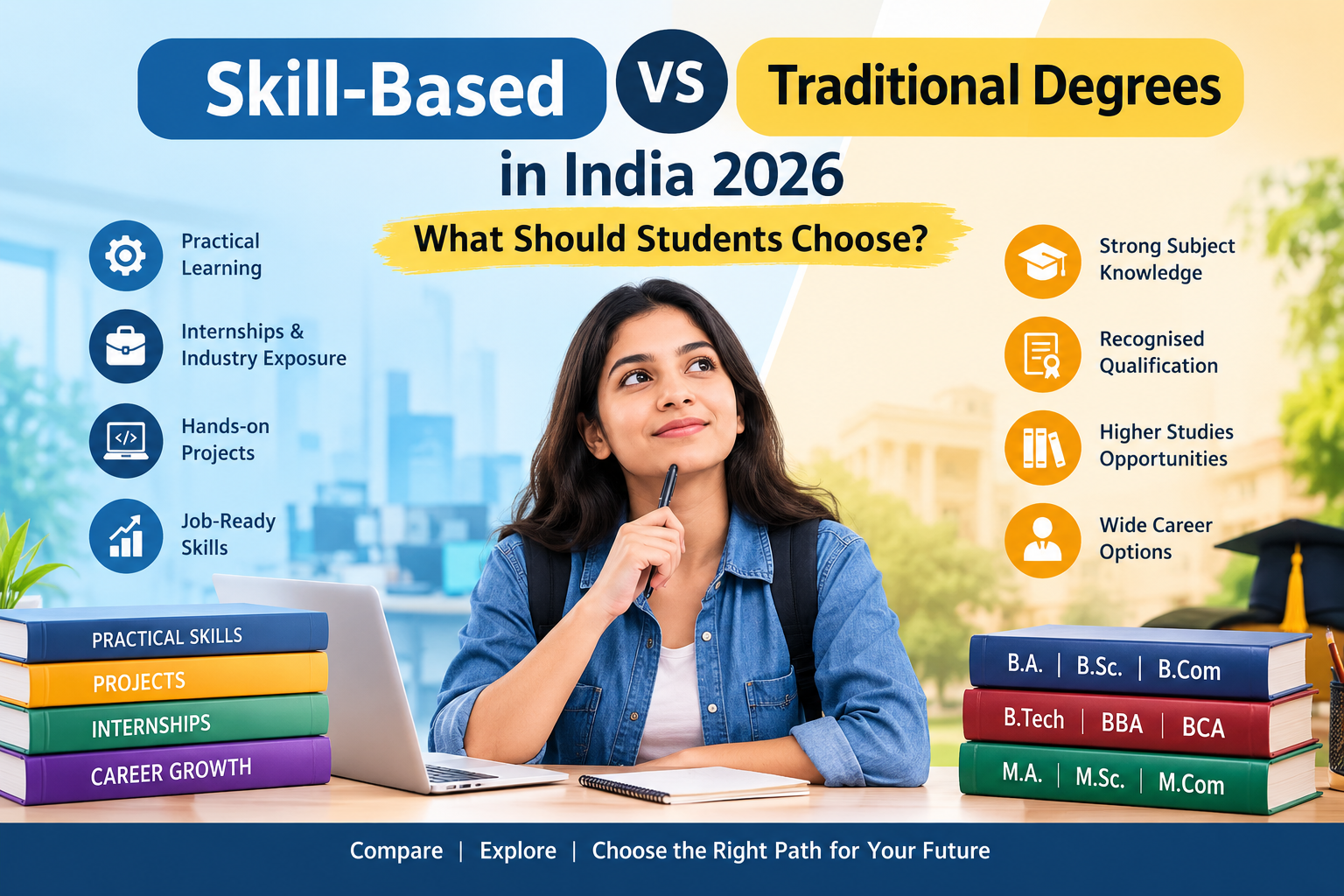
Skill-Based vs Traditional Degrees is an important question for Indian students choosing a course after Class 12. Traditional degrees can provide strong subject knowledge and recognised degree, while skill-focused programmes can give students more practical training, projects and industry exposure.
However, students do not always have to choose between the two. In many cases, a recognised degree combined with useful skills, internships and practical experience can create a stronger career path.
This guide compares both options and explains the differences in courses, fees, practical learning, internships, career choices and future study options.
Skill-Based Degrees vs Traditional Degrees in India — which option should you choose?
A traditional degree can give you strong subject knowledge and a recognised degree. On the other hand, a skill-focused course can give you more practical training. In many cases, students can benefit from both.
Therefore, the real question is not simply “degree or skills?”
Instead, ask:
What course gives me the right qualification, useful skills and a good path to my career?
This guide explains the difference between traditional degrees and skill-focused programmes. It also covers courses, costs, practical learning, internships, career options and the main points students should check before admission.
Important: “Skill-based degree” is not one fixed type of degree in India. Different colleges may use this term for practical courses, vocational programmes, internships, projects or industry training. Therefore, always check the university, course, syllabus and recognition before taking admission.
Why Are Students Talking About Skills in 2026?
Skill-Based vs Traditional Degrees: What Should Students Know?
India has a very large higher-education system.
The latest completed AISHE data cited by the Ministry of Education recorded nearly 4.46 crore students in higher education in 2022-23. It also recorded 58,643 higher-education institutions.
Because there are so many colleges and courses, students now have many more choices.
At the same time, getting a degree is not the only thing students think about. Many also want internships, projects and work skills.
The India Skills Report 2026 reported overall employability at 56.35%. The report also gave different figures for different study areas. For example, it reported 80% for Computer Science, 78% for IT, 70.15% for BE/BTech, 62.81% for Commerce and about 55.55% for Arts.
However, these figures are employability measures from that report. They are not college placement percentages. They also do not mean that students are guaranteed a job.
So, what does this tell students?
A degree still matters. At the same time, useful skills can also help when students look for work.
What Is a Traditional Degree?
A traditional degree is an established academic or professional course.
Common examples include:
- BA
- BSc
- BCom
- BTech
- BE
- MBBS
- BDS
- BBA
- Law
- MA
- MSc
- MCom
These courses usually follow a set study plan. Students attend classes, complete exams and study a subject in depth.
For many careers, this type of qualification is essential.
For example, a short certificate cannot replace the education needed to become a doctor. Similarly, some professional careers have their own qualification rules.
Benefits of Traditional Degrees
A traditional degree can give students:
- Strong subject knowledge
- A recognised degree
- A clear study path
- Access to higher studies
- Eligibility for many exams
- Academic and research options
- A route to many professional careers
For example, BCom can give a strong base in accounts and business. Likewise, BSc can build science knowledge. BA can help students study subjects such as economics, history, English or political science.
However, classroom study alone may not give enough practical experience for every career.
Therefore, adding useful skills during college can be a good idea.
What Is a Skill-Based Degree?
The term “skill-based degree” can mean different things.
In simple words, it usually means a programme that gives more focus to practical work along with classroom study.
Such programmes may include:
- Projects
- Internships
- Practical classes
- Industry tools
- Workplace training
- Apprenticeships
- Portfolio work
- Industry certificates
One formal example is B.Voc, which stands for Bachelor of Vocation.
NEP 2020 supports B.Voc programmes and also supports wider vocational learning in higher education.
Besides B.Voc, some colleges offer BCA, BBA, BSc, BTech and other degrees with more practical and industry-focused learning.
Still, students should not choose a course only because its name contains words such as:
- AI
- Data Science
- FinTech
- Cybersecurity
- Job Ready
- Future Ready
- Industry Ready
Instead, read the full syllabus and find out what students actually learn.
Skill-Based Degrees vs Traditional Degrees: Simple Comparison
Skill-Based vs Traditional Degrees: Which Students May Prefer Each Option?
| Factor | Traditional Degree | Skill-Focused Degree or Programme |
|---|---|---|
| Main focus | Subject knowledge and academic study | Subject knowledge plus practical skills |
| Theory | Usually stronger | Combined with more practical work |
| Projects | Depends on the course | Often given more focus |
| Internship | Depends on college | Often highlighted |
| Industry exposure | Varies | May be higher |
| Higher studies | Strong pathway | Usually possible, depending on course |
| Professional careers | Important for many fields | Depends on qualification |
| Portfolio | Less important in some fields | Often useful in creative and digital fields |
| Job preparation | Depends on college and student | May have stronger practical training |
The course title does not tell you everything.
For example, a good BCom with internships may be more useful than a weak course that uses the words “skill-based.”
Likewise, a strong practical programme can suit a student who learns better by doing.
What Does NEP 2020 Say About Skills?
The move toward practical learning is also linked to India’s National Education Policy 2020.
NEP 2020 supports vocational education, internships, multidisciplinary learning and closer links between education and work.
In addition, UGC has initiatives related to:
- Academic Bank of Credits
- Multiple Entry and Exit
- National Credit Framework
- Undergraduate curriculum changes
- Multidisciplinary education
These changes aim to make higher education more flexible.
As a result, students can get more ways to combine academic study with practical learning.
Important Numbers About Higher Education
Numbers can help students understand the size of India’s education system.
| Indicator | Latest available figure |
|---|---|
| Higher-education enrolment, 2022-23 | Nearly 4.46 crore |
| Higher-education institutions, 2022-23 | 58,643 |
| Higher-education enrolment, 2014-15 | 3.42 crore |
| India Skills Report 2026 overall employability | 56.35% |
| Computer Science employability in report | 80% |
| IT employability in report | 78% |
| BE/BTech employability in report | 70.15% |
| Commerce employability in report | 62.81% |
| Arts employability in report | About 55.55% |
It is important to read these numbers correctly.
For example, 56.35% employability does not mean that 56.35% of graduates got jobs. The figure comes from the India Skills Report and its assessment method.
Therefore, students should use these numbers as background information. They should not treat them as job guarantees.
What Skills Can Help Students in 2026?
The right skills depend on the career.
Still, many students can build useful skills such as:
- Communication
- Professional writing
- Problem-solving
- Excel
- Data skills
- Presentation
- Research
- Digital tools
- AI literacy
- Coding
- Business analysis
- Design tools
- Teamwork
- Project work
- Internship experience
For example, a software developer needs coding skills.
On the other hand, a finance student may need Excel, accounting software and financial analysis.
Similarly, a designer may need design software and a strong portfolio.
So, choose skills that match the type of work you want to do.
Why Degree + Skills Can Be a Good Combination
Students sometimes think they must choose either a degree or skills.
That is not always true.
Instead, many students can build both at the same time.
For example:
BCom + Excel + Accounting Software + Internship
BBA + Digital Marketing + Analytics + Internship
BA English + Content Writing + SEO + Portfolio
BSc + Data Analysis + Research Projects
BTech + Coding + Cloud + Projects
BDes + Design Software + Portfolio
The degree gives the student formal education.
Next, the practical skill helps the student perform useful work.
Then, projects and internships give the student proof of that work.
As a result, the student can build a more complete career profile.
B.Voc: A Degree With a Practical Focus
Students who enjoy practical learning should also know about B.Voc.
B.Voc means Bachelor of Vocation. It is a degree programme with a stronger focus on vocational and practical learning.
Depending on the college, B.Voc courses may be available in areas such as:
- Healthcare
- IT
- Banking and finance
- Retail
- Tourism
- Agriculture
- Media
- Food processing
- Software
- Other vocational fields
However, do not choose B.Voc only because it sounds practical.
Before admission, check:
- University recognition
- Course syllabus
- Practical training
- Internship
- Total fees
- Career options
- Higher-study options
What Is an Industry-Linked Degree?
An industry-linked programme may include:
- Industry projects
- Internships
- Guest lectures
- Practical assignments
- Apprenticeships
- Industry certificates
- Workplace training
However, the words “industry-linked” do not prove that the course is good.
Instead, ask:
Which companies are involved?
What will students actually do?
How long is the internship?
Is the internship compulsory?
How many students get the opportunity?
Does the training match the course?
These questions can help students understand whether the industry link is real.
Apprenticeships: Another Way to Learn
An apprenticeship allows students to learn in a real work setting.
The government’s National Apprenticeship Training Scheme (NATS) supports apprenticeship opportunities for eligible students and graduates.
For 2024-25, the NATS dashboard recorded 5,49,296 contracts created and 5,23,087 contracts approved.
These are apprenticeship contracts. They are not permanent jobs and should not be read as the number of students who found jobs.
Even so, apprenticeships can add useful work experience.
Classroom learning teaches the basics. Work experience shows students how those ideas are used in real situations.
Government Skill-Learning Options
Students do not always need to spend a large amount of money on extra courses.
For example, SWAYAM Plus currently lists more than 6.83 lakh registered learners, 500+ courses and 77 industry partners.
The platform focuses on industry-linked learning. Some courses may also support academic credit under the applicable system.
Therefore, students can explore these options along with their main degree.
Useful resources include:
- UGC
- SWAYAM Plus
- NATS
- Ministry of Skill Development and Entrepreneurship
- APAAR
- Academic Bank of Credits
Skill-Based vs Traditional Degrees: Compare the Cost
The cost can change a lot from one college to another.
For basic planning, students may see broad ranges like these:
| Education option | Broad planning range |
|---|---|
| Government/Public BA, BCom or BSc | ₹30,000–₹2.5 lakh+ tuition |
| Private BA, BCom or BSc | ₹2–8 lakh+ |
| BCA or BBA | ₹1.5–10 lakh+ |
| B.Voc | ₹60,000–₹5 lakh+ |
| BTech | ₹2–20 lakh+ |
| Short skill course | Free to ₹1 lakh+ |
| Professional certification | ₹5,000–₹1.5 lakh+ |
These are only broad planning ranges.
Actual costs can change because of:
- College
- City
- University
- Course
- Hostel
- Food
- Travel
- Equipment
- Certification
- Scholarship
Therefore, always check the current official fee details before making a payment.
Who Should Choose a Traditional Degree?
A traditional degree may suit you when:
- You need a specific qualification
- You want higher studies
- You enjoy academic learning
- You plan to enter research
- You are preparing for competitive exams
- You want a broad academic base
For example, becoming a doctor requires the required medical education.
Likewise, several professional careers have their own qualification rules.
Even then, practical skills can add value.
Who Should Choose a Skill-Focused Programme?
A skill-focused programme may suit you when:
- You enjoy learning by doing
- You want more project work
- You like technology
- You want industry exposure
- You enjoy creative work
- You want to build a portfolio
- You want internship experience
Even so, check recognition first.
A skill-based label cannot replace a recognised degree when a formal qualification is required.
Which Option Is Better for Different Students?
The right option depends on the career goal.
Student 1: Wants to Become a Doctor
A student who wants to become a doctor needs the required medical education and training.
A short skill certificate cannot replace that path.
Practical approach: Professional degree + clinical training + required registration.
Student 2: Wants to Become a Software Developer
Possible degree routes include:
- BTech
- BCA
- BSc Computer Science
The exact choice depends on eligibility, budget and college.
Useful skills include:
- Programming
- Databases
- Cloud
- AI tools
- Projects
- Internships
Practical approach: Recognised degree + coding + projects + internship.
Student 3: Wants a Finance Career
Possible paths include:
- BCom
- BBA
- Economics
- Finance
- CA
- CMA
Useful skills include:
- Excel
- Accounting software
- Financial analysis
- Power BI
- Internship experience
Practical approach: Degree or professional qualification + finance skills.
Student 4: Wants a Creative Career
Possible options include:
- BDes
- BFA
- Animation
- VFX
- Media
- Communication
Here, a strong portfolio can be very useful.
Practical approach: Relevant degree + design tools + portfolio + projects.
Student 5: Wants More Practical Exposure
Options can include:
- B.Voc
- Polytechnic
- ITI
- Apprenticeships
- Industry-linked programmes
- Skill certifications
However, check whether the qualification allows you to continue your studies later.
What If You Are Still Confused?
Many Class 12 students do not know their final career.
That is normal.
In this situation, avoid choosing a narrow course only because it is popular online.
Instead, consider a course that gives you room to explore.
For example:
- BCom + finance skills
- BSc + data skills
- BA + communication skills
- BBA + analytics
- BCA + programming
Meanwhile, internships and short courses can help you test your interests.
You do not have to decide your whole working life at age 18.
Instead, focus on making a sensible next-step decision.
How Parents Can Help Students
Parents can ask a few simple questions before admission:
- Is the qualification recognised?
- What will the student learn?
- How much practical training is included?
- Is the internship genuine?
- What is the full cost?
- What does the placement data show?
- What higher-study options are available?
- What happens if the student changes career direction?
These questions are more useful than asking only which course offers the “highest package.”
Warning Signs Before Choosing a Course
Be careful when an institution promises:
- “100% job guarantee”
- “Guaranteed salary”
- “Guaranteed placement”
- “Future-proof career”
- “Government approved” without details
- “International degree” without naming the university
- “Industry recognised” without naming the partner
- Very high fees for a few short certificates
- No clear syllabus
- No internship details
- No placement report
- No clear degree-awarding university
Before paying any money, ask for complete details in writing.
How to Choose the Right Course in 2026
Follow these steps.
Step 1: Decide the career area
First, think about the type of work you enjoy.
Step 2: Check the qualification
Next, find out which degree or qualification the career needs.
Step 3: Compare colleges
Then, compare recognition, faculty, fees, facilities and placement information.
Step 4: Read the syllabus
Do not judge a course only from its name.
Step 5: Check practical learning
Look for labs, projects, internships and industry work.
Step 6: Calculate the full cost
Include tuition, hostel, food, travel and other expenses.
Step 7: Check higher-study options
Find out what you can study after graduation.
Step 8: Add career skills
Choose skills that match the job you want.
Step 9: Build proof
Create projects, portfolios and internship experience.
Step 10: Make the final choice
Finally, select the option that fits your goals, ability and budget.
Skill-Based vs Traditional Degrees: Career Examples
| Degree | Useful Skills | Useful Evidence |
|---|---|---|
| BCom | Excel, accounting software, GST, Power BI | Finance project + internship |
| BBA | Marketing, analytics, communication | Marketing project |
| BA English | Writing, SEO, editing | Writing portfolio |
| BSc | Data analysis, statistics, research | Research project |
| BCA | Programming, databases, cloud | Software projects |
| BTech | Coding, AI, cloud, cybersecurity | Projects + internship |
| BDes | Design software, UX | Design portfolio |
| BA Economics | Statistics, Excel, data tools | Data projects |
The right combination depends on your career goal.
Does a High Salary Mean a Better Course?
Not necessarily.
Salary can depend on:
- College
- Industry
- Job role
- Location
- Skills
- Experience
- Communication
- Internship
- Market conditions
Therefore, do not choose a course only because someone mentions a high package.
Instead, ask:
What will I learn?
Which jobs can I apply for?
What is the total cost?
Which skills will I need?
What higher-study options are available?
These questions give you a better picture.
Can Skill-Based Learning Replace Higher Education?
Sometimes, students can start work after an undergraduate course.
However, some careers require more education or a specific professional qualification.
For example, medicine, research and some specialised careers may require further study.
Therefore, do not assume that a short skill course can replace higher education in every profession.
The right path depends on your career.
Official Resources for Students
University Grants Commission
Use the UGC website for higher-education information and major initiatives.
SWAYAM Plus
Explore industry-linked learning and useful courses.
National Apprenticeship Training Scheme
Explore apprenticeship opportunities and official information.
Ministry of Skill Development and Entrepreneurship
Learn more about India’s skill-development system and programmes.
APAAR
Explore information about student academic records and related services.
Related Articles From Admission Mantra
Students comparing degrees and skills can also read these related Admission Mantra guides.
Best Courses After 12th in India
Compare courses for Science, Commerce and Arts students, including duration, fees, career scope and admission routes.
Read: Best Courses After 12th in India
How to Choose the Right College After 12th
Learn how to compare recognition, fees, placements, internships, hostel and admission rules.
Read: How to Choose the Right College After 12th
Courses Without NEET in India
Explore healthcare and allied-health courses for students considering options beyond MBBS.
Read: 10 Courses Without NEET in India
Admission Mantra Blog
Explore more articles on courses, admissions, medical education, engineering and career planning.
Visit the Admission Mantra Blog
Frequently Asked Questions
Are skill-based degrees better than traditional degrees?
Not automatically, because the right choice depends on the career, college, qualification, practical training, cost and future plans.
Are traditional degrees still useful in 2026?
Yes, because traditional degrees remain important for many professional, academic, government and higher-study paths.
Is every skill-based course a recognised degree?
No, because some programmes are degrees while others are diplomas or certificates. Therefore, check the degree-awarding university and official recognition before admission.
Is B.Voc a degree?
Yes, B.Voc is a formal vocational degree route.
Should I choose BTech or BCA for a technology career?
Both can lead to technology careers. However, they are different programmes, so compare eligibility, syllabus, fees, college quality and practical learning before deciding.
Can BCom students learn technology skills?
Yes, BCom students can learn Excel, Power BI, data analysis, accounting software and other digital skills.
Can BA students build a good career?
Yes, BA students can add writing, research, communication, SEO, data or other useful skills, depending on their subject and career goal.
Is a certificate enough for a job?
It depends on the job. While some roles value short certificates, others need a formal degree or professional qualification.
Are internships important?
Yes, internships can give students useful work experience. However, the quality of the internship matters more than simply having an internship certificate.
Should I choose a course because it promises a high salary?
No, because salary depends on many factors, such as the job role, company, college, skills, experience and market conditions.
What is a practical approach for most students?
For many students, a good approach is:
Recognised Degree + Relevant Skills + Projects + Internship + Continuous Learning
Final Conclusion
The debate around Skill-Based Degrees vs Traditional Degrees in India is not really about choosing one side.
A traditional degree can provide strong subject knowledge and a recognised degree. On the other hand, practical skills can help students use that knowledge in real work.
Therefore, the best approach for many students is to combine both.
Recognised Degree + Relevant Skills + Projects + Internship + Continuous Learning
Before admission, check the university, course, syllabus, fees, practical training and career options.
Also, do not choose a course only because it sounds modern. At the same time, do not reject a traditional degree just because it sounds old.
Instead, choose the path that fits your career goal, interests, budget and learning style.
Your degree gives you the foundation, while your skills show what you can do. In the end, your projects and experience help you prove it.
Need Help Choosing the Right Course?
Admission Mantra helps students and parents compare courses, colleges, eligibility, fees, admission routes and career options before making an important education decision.
Admission Mantra Pvt Ltd
Sanjaynagar, Bangalore
Sharpen your future. Choose your course with clarity.