
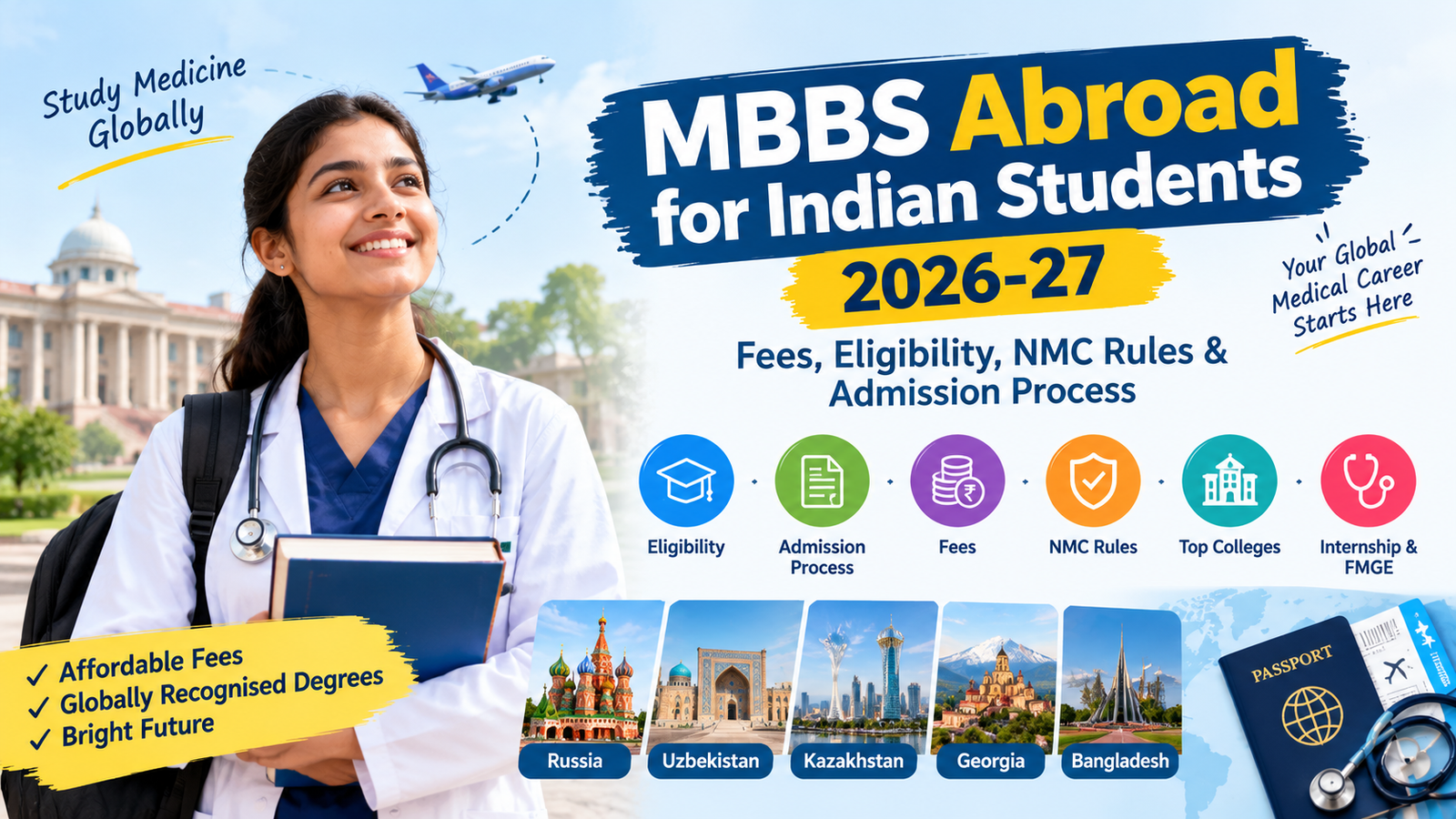
MBBS Abroad for Indian Students 2026-27: Fees, Eligibility, NMC Rules & Admission Process
MBBS abroad for Indian students can be an option for students who want to study medicine outside India. However, choosing a foreign medical university requires careful checking. The lowest fee or an attractive advertisement does not automatically mean that a medical degree will be suitable for practice in India.
Students should check the university, course duration, medium of instruction, clinical training, internship, local registration, total cost and the requirements for medical registration in India before taking admission.
This complete guide explains MBBS abroad for Indian students in 2026-27, including eligibility, NEET requirements, NMC rules, admission steps, fees, popular destinations, university checks, internship requirements and the current FMGE system.
Important: Rules for foreign medical graduates can change. Always verify the latest NMC, NTA, NBEMS and university information before paying any admission fee.
Why Do Indian Students Consider MBBS Abroad?
Medical education outside India can attract students for several reasons.
For some families, the total cost may be lower than selected private medical colleges in India. In addition, some foreign universities offer English-medium medical programmes and international exposure.
However, students should compare the complete cost rather than tuition alone.
Consider:
- Tuition fees
- Hostel fees
- Food
- Travel
- Visa and insurance costs
- Medical tests
- Books and study materials
- Local transportation
- Currency exchange
- Internship-related expenses
- Future examination and registration costs
Therefore, MBBS abroad for Indian students should be treated as a long-term education decision, not simply as a cheaper alternative.
Is MBBS Abroad Valid in India?
A foreign medical degree is not automatically accepted for medical practice in India.
The National Medical Commission (NMC) says that it does not approve or recognise foreign medical universities through an NMC-approved foreign-university list. Instead, students must ensure that their foreign medical education meets the applicable regulatory requirements. NMC advises students to obtain course and fee details directly from the foreign institution and to check whether the course meets the required standards.
For students governed by the Foreign Medical Graduate Licentiate (FMGL) Regulations, 2021, important requirements include:
- At least 54 months of medical education in the foreign medical institution
- At least 12 months of internship in the same foreign medical institution
- The required medical training and clinical education
- English as the medium of instruction
- Study of the subjects prescribed under the FMGL framework
- Eligibility for registration or licensing as a medical practitioner in the country where the degree was awarded
- Passing the applicable licensing or screening examination in India
- Completion of the required supervised internship in India where applicable
NMC has also advised students to verify that the foreign course is compliant before admission.
Important: Do not look for an “NMC-approved foreign college list”
This is one of the most important points for students.
NMC has specifically stated that it does not approve or recognise foreign medical institutions or universities as an “approved list.” Therefore, a consultant’s statement that a university is “NMC approved” should not be accepted as proof on its own.
Instead, students should verify the university and programme against the current NMC rules and obtain written information directly from the university.
NEET Requirement for MBBS Abroad
For Indian citizens and Overseas Citizens of India intending to pursue undergraduate medical education in a foreign medical or dental institution, NEET qualification is required under the NEET-UG framework. The NEET-UG 2026 information bulletin states that Indian citizens/OCIs intending to pursue undergraduate medical courses in a foreign medical or dental institute need to qualify NEET-UG.
However, students should not interpret this as meaning that a high Indian MBBS counselling rank is automatically required for every foreign university.
Foreign universities can have their own admission requirements. Therefore, check:
- NEET qualification
- Class 12 subjects
- PCB marks
- University eligibility
- Admission deadline
- Passport requirements
- Medical fitness requirements
- Country-specific rules
Always use the latest NEET bulletin for the applicable year.
Eligibility for MBBS Abroad for Indian Students
Educational Qualification
Students generally need to complete Class 12 or an equivalent qualification with the required medical subjects.
The usual subjects include:
- Physics
- Chemistry
- Biology or Biotechnology
- English
The exact admission requirements should be confirmed with both the relevant Indian rules and the foreign university.
NEET Qualification
Indian citizens and eligible OCI candidates intending to pursue undergraduate medical education abroad must qualify NEET as required under the applicable rules.
Age
NEET-UG 2026 provides for a minimum age requirement, while NTA notes that there is no upper age limit for NEET under the applicable rules. Students should check the current year’s bulletin rather than relying on older admission articles.
Important Note About 50% and 40% Rules
Do not use a blanket statement such as “50% for General and 40% for SC/ST/OBC” as the complete eligibility rule for every foreign university.
The student’s eligibility depends on the applicable NEET/NMC rules and the admission requirements of the foreign institution. Therefore, verify the current NEET bulletin and university eligibility before applying.
Popular Countries Considered for MBBS Abroad
Indian students commonly explore countries such as:
- Russia
- Uzbekistan
- Kazakhstan
- Georgia
- Bangladesh
- Kyrgyzstan
- Other countries offering foreign medical programmes
However, a country should not be selected only because its fee is low.
Instead, compare the university and programme on:
- Course duration
- Clinical training
- Medium of instruction
- Internship structure
- Local medical registration
- Hospital exposure
- Faculty
- Accommodation
- Safety
- Total cost
- Compliance with NMC requirements
Important 2026 Warning for Students Considering Uzbekistan
NMC issued an advisory on 1 April 2026 for Indian students seeking admission to undergraduate medical courses in Uzbekistan. The advisory refers to earlier notices and urges students and parents to follow the prescribed guidelines and exercise caution before taking admission.
Therefore, students should not choose an Uzbek medical university only because an agent promises low fees or easy admission.
How to Choose a Foreign Medical University
There is no single “best MBBS abroad college” for every Indian student.
Instead, compare the actual university and programme.
1. Check the university directly
Ask the university for:
- Official admission letter
- Course name
- Total programme duration
- Tuition fee
- Hostel fee
- Internship structure
- Hospital details
- Medium of instruction
- Clinical training details
- Local medical registration information
2. Check the course structure
Under the FMGL framework, course duration and clinical training matter. NMC has specified requirements including minimum medical education duration and a 12-month internship at the same foreign medical institution for students governed by those regulations.
3. Check the medical school in WDOMS
The World Directory of Medical Schools (WDOMS) can be used to check whether a medical school is listed.
However, there is an important difference:
WDOMS listing does not itself mean that a medical school is recognised, accredited or endorsed by WDOMS, WFME or FAIMER.
So WDOMS should be treated as one verification tool, not proof that a university automatically meets NMC requirements.
4. Check local recognition
The medical school should be legally recognised or authorised to provide the medical qualification in its own country.
Also verify whether graduates are eligible for medical registration in that country.
This is important because the FMGL rules include requirements relating to registration or licensure in the country where the degree is awarded.
Examples of Foreign Medical Universities
Students may come across universities such as:
Russia
- Kazan Federal University
- Bashkir State Medical University
- Orenburg State Medical University
- Other Russian medical universities
Uzbekistan
- Tashkent-based medical universities
- Samarkand-based medical universities
- Other state and authorised medical institutions
Kazakhstan
- Al-Farabi Kazakh National University
- Kazakh National Medical University
- Other medical institutions
Georgia
- Tbilisi State Medical University
- Other Georgian medical universities
Bangladesh
- Dhaka-based medical colleges
- Other recognised private and public medical institutions
Important: These examples should not be described as an “NMC-approved list.” NMC itself says it does not endorse a list of foreign medical institutions. Students must verify the specific institution, programme and admission year before enrolling.
MBBS Abroad Fees for Indian Students
The cost of MBBS abroad for Indian students can vary widely.
It depends on:
- Country
- University
- Course duration
- Tuition fee
- Hostel
- Food
- City
- Currency exchange rate
- Clinical training
- Travel
- Other university charges
Indicative Planning Range
The following broad ranges can be used only for initial planning. They are not official fee schedules and should not be treated as guaranteed costs.
| Country | Indicative Total Tuition/Study Budget* |
|---|---|
| Russia | ₹25–40 lakh |
| Uzbekistan | ₹18–30 lakh |
| Kazakhstan | ₹20–30 lakh |
| Georgia | ₹30–45 lakh |
| Bangladesh | ₹30–45 lakh |
*Actual costs vary by university and admission year. Hostel, food, travel, visa, insurance and other expenses may be extra. Obtain the official fee schedule directly from the university before paying.
Do Not Compare Only Tuition Fees
For example, a university with low tuition may have higher hostel, food or travel costs.
Therefore, calculate:
Total Cost = Tuition + Hostel + Food + Travel + Visa + Insurance + Study Materials + Other Charges
Also ask whether the university increases fees during the course.
MBBS Abroad Admission Process for Indian Students
Step 1: Qualify NEET
Indian citizens/eligible OCI candidates intending to study undergraduate medical education abroad need to qualify NEET according to the applicable rules.
Step 2: Shortlist Countries and Universities
Compare universities based on:
- NMC regulatory requirements
- Course duration
- Clinical training
- Total cost
- Local recognition
- Language
- Hospital facilities
- Student support
Step 3: Verify the University
Do not rely only on a consultant.
Check the information directly with the university and use the relevant official medical-education databases and regulators.
Step 4: Apply to the University
Common documents can include:
- Class 10 certificate
- Class 12 certificate
- NEET scorecard
- Passport
- Passport-size photographs
- Medical certificate
- Other university-specific documents
Step 5: Receive the Official Admission Letter
The university should issue its official admission or offer letter.
Check the course name, duration, fee and other conditions carefully.
Step 6: Pay Fees Through the Official Process
Before paying, confirm:
- Beneficiary name
- Bank details
- Fee amount
- Refund policy
- Payment deadline
- Official receipt
Avoid transferring money to an individual’s personal bank account without proper verification.
Step 7: Apply for the Student Visa
Visa requirements vary by country.
They may include:
- Passport
- Admission letter
- Visa application
- Financial documents
- Medical documents
- Photographs
- Other country-specific documents
Step 8: Join the University
After receiving the required visa and travel documents, students can travel and complete the university joining process.
How Long Does MBBS Abroad Take?
For students covered by the FMGL Regulations 2021, NMC requirements include a minimum 54 months of medical education and a minimum 12-month internship in the same foreign medical institution. That means the foreign medical education plus internship is at least 66 months, or about 5.5 years.
In addition, eligible foreign medical graduates may need to complete a minimum 12-month supervised internship in India after fulfilling the applicable examination and registration requirements.
Therefore, students should not simply advertise an MBBS-abroad programme as “5 years” without explaining the full registration pathway.
Medium of Instruction
For students governed by the FMGL Regulations, English is an important requirement for the foreign medical qualification.
NMC’s FMGL guidance specifies English as the medium of instruction. It also requires the prescribed medical subjects and practical/clinical training.
At the same time, students may need to learn the local language for communication with patients.
For this reason, ask the university:
- Is the academic course taught in English?
- How are clinical postings conducted?
- Is local-language training provided?
- Which hospitals are used for clinical training?
- How much patient interaction is available?
FMGE After MBBS Abroad
As of 2026, FMGE remains the active screening examination for eligible foreign medical graduates.
NBEMS conducts the Foreign Medical Graduate Examination (FMGE), and its current website provides the examination bulletin, application information and results.
The FMGE information bulletin states that the examination has 300 questions, is conducted in two parts, and a candidate needs at least 150 marks out of 300 to pass.
What About NExT?
NExT is planned as a future common licensing and qualifying examination.
However, NMC’s March 2026 FAQ states that NExT is not currently operational. It will replace the existing relevant examinations after it becomes operational under the applicable framework.
Therefore, students should not write “FMGE/NExT” as though both are currently interchangeable.
For students seeking admission in 2026-27, always check the latest NMC and NBEMS notices.
Internship Requirements After MBBS Abroad
Internship is one of the most important parts of the foreign medical course.
Under the applicable FMGL framework, students need the required internship in the same foreign medical institution, followed by the required supervised internship in India for those who are required to complete it.
NMC continues to issue notices regarding allocation of CRMI internship slots for foreign medical graduates. For example, NMC issued a circular in March 2026 addressing allocation of CRMI slots for FMGs.
This is why students should ask about internship arrangements before admission, not after graduation.
Advantages of MBBS Abroad
For some students, studying medicine abroad may offer:
- More university choices
- International exposure
- Potentially different fee structures
- Experience in another healthcare system
- English-medium programmes at some universities
- Exposure to diverse patient settings
However, these benefits depend on the actual university.
A foreign medical degree also comes with additional steps for students who want to practise in India.
Challenges of MBBS Abroad
Before choosing MBBS abroad for Indian students, understand the possible challenges.
Licensing exam
Students planning to practise medicine in India need to meet the applicable screening/licensing requirements.
Clinical exposure
The quality and amount of clinical exposure can vary between universities.
Language
Even when the classroom teaching is in English, local-language skills may be important during hospital postings.
Distance from family
Students need to adjust to a different country, culture, climate and education system.
Currency changes
Exchange-rate changes can increase the actual cost for an Indian family.
Internship planning
Students should understand the full foreign and Indian internship pathway before admission.
Recognition and compliance
A low-cost university is not useful for an Indian student if its programme does not meet the applicable regulatory requirements.
Common Mistakes Students Should Avoid
Choosing a university because an agent says “NMC approved”
NMC does not endorse a general list of foreign MBBS universities. Verify the university and programme yourself.
Choosing only the lowest fee
Low tuition does not always mean low total cost.
Ignoring the internship
Ask where the internship will take place and whether it meets the applicable requirements.
Ignoring clinical training
A medical degree requires proper practical and clinical education.
Trusting “guaranteed FMGE” claims
No consultant should guarantee that a student will clear a licensing examination.
Paying money without verification
Use official university payment channels and keep every receipt.
Assuming WDOMS listing means Indian recognition
WDOMS itself says that listing does not mean recognition, accreditation or endorsement.
Ignoring current NMC advisories
NMC can issue country- or university-related advisories. Students should check the latest notices before applying.
Is MBBS Abroad Worth Considering in 2026-27?
MBBS abroad can be considered by Indian students who understand the full pathway and are ready to meet the applicable regulatory requirements.
It may suit a student who:
- Has qualified NEET
- Wants to study medicine outside India
- Has carefully compared the total cost
- Has verified the university and course
- Understands the internship requirements
- Is prepared for the Indian licensing pathway
- Is comfortable living and studying abroad
However, students should not choose a foreign medical university simply because admission appears easy or the fees look low.
The more important question is:
Will this specific medical programme meet the requirements I need for my future registration and career?
Official Sources Students Should Check
National Medical Commission
Use the National Medical Commission (NMC) website for current rules and advisories relating to foreign medical graduates.
NEET-UG
Use the NEET-UG official portal for the latest NEET information and the annual information bulletin.
NBEMS / FMGE
Use the NBEMS FMGE section for FMGE applications, information bulletins, notices and results.
World Directory of Medical Schools
Use WDOMS to search for international medical schools. Remember that a WDOMS listing by itself does not mean NMC approval or accreditation.
Related Medical Admission Guides from Admission Mantra
Planning your medical education involves more than choosing a university. You should also understand NEET, MBBS seat availability, counselling, college selection and alternative healthcare courses. Explore these related guides from Admission Mantra:
NEET 2026 Medical Admission: Why Not You?
Understand the NEET 2026 admission process, MBBS seat options, counselling, college choices, fees and important factors after the NEET result.
Read: NEET 2026 Medical Admission – Why Not You?
Karnataka MBBS Seats Increased by 1,650 in 2026
Learn about the latest Karnataka MBBS seat increase for the 2026-27 academic year and understand how the additional seats may affect medical admission planning.
Read: Karnataka MBBS Seat Increase 2026
Medical Admissions in Karnataka: Complete Guide
Explore medical courses, counselling, college selection, fees and important factors students should check before choosing a medical college.
Read: Medical Admissions in Karnataka
Courses Without NEET in India: 10 Healthcare Careers
Students who want to build a healthcare career but are considering alternatives to MBBS can explore nursing, physiotherapy, medical imaging, laboratory technology, pharmacy and other healthcare courses.
Read: 10 Healthcare Courses Without NEET
NEET 2027 Computer-Based Test: Latest Update & Guide
Students planning for a future medical admission can also learn about the latest NEET 2027 computer-based test update, eligibility, exam pattern and preparation guidance.
Read: NEET 2027 Computer-Based Test Guide
Frequently Asked Questions
Is NEET compulsory for MBBS abroad?
For Indian citizens and eligible OCI candidates intending to pursue undergraduate medical education in a foreign medical or dental institution, NEET qualification is required under the applicable NEET-UG rules.
Does NMC approve foreign medical universities?
NMC states that it does not approve or recognise foreign medical institutions or universities through an NMC-approved list. Students must instead verify the university and programme against the applicable regulations.
Is MBBS abroad valid in India?
A foreign medical qualification is not automatically enough to practise in India. Graduates must satisfy the applicable NMC requirements, examination requirements and registration process.
Is FMGE still required in 2026?
FMGE remains an active screening examination conducted by NBEMS in 2026. NMC’s March 2026 FAQ states that NExT is not currently operational.
How long is MBBS abroad?
For students governed by the FMGL Regulations 2021, the foreign medical education requires at least 54 months of medical education plus a minimum 12-month internship at the same foreign medical institution. Further supervised internship requirements in India may also apply.
Does WDOMS listing mean that a university is approved by NMC?
No. WDOMS itself states that listing does not mean recognition, accreditation or endorsement.
Which country is the cheapest for MBBS abroad?
There is no single cheapest country for every student. Fees change by university, city, exchange rate and academic year. Compare the complete cost instead of tuition alone.
Can a consultant guarantee FMGE success?
No consultant can guarantee examination success. Students should research the university, study seriously and understand the licensing requirements before admission.
What should I check before paying an MBBS-abroad admission fee?
Verify the university, course duration, medium of instruction, clinical training, internship, local recognition, total fees, refund policy and the applicable NMC requirements.
Final Conclusion
MBBS abroad for Indian students can be a serious option for students who want to study medicine outside India. However, it should never be treated as a simple shortcut to becoming a doctor in India.
Before choosing a university, check the course, duration, clinical training, internship, local recognition, total cost and Indian licensing requirements.
Most importantly, do not rely only on claims such as “NMC approved,” “guaranteed FMGE,” “lowest fees” or “100% success.”
Verify the information directly from the National Medical Commission, NTA, NBEMS, the university and relevant official authorities.
A well-informed decision starts with verification, not just admission.
Need Guidance for MBBS Abroad?
Admission Mantra helps students and parents understand medical admission options, eligibility, documentation, counselling and course choices.
Admission Mantra Pvt Ltd
Sanjaynagar, Bangalore
Sharpen your future. Make your admission decision with the right information.