
NEET 2027 Computer Based Test: Latest Update, Exam Pattern & Preparation Guide:
NEET 2027 computer based test
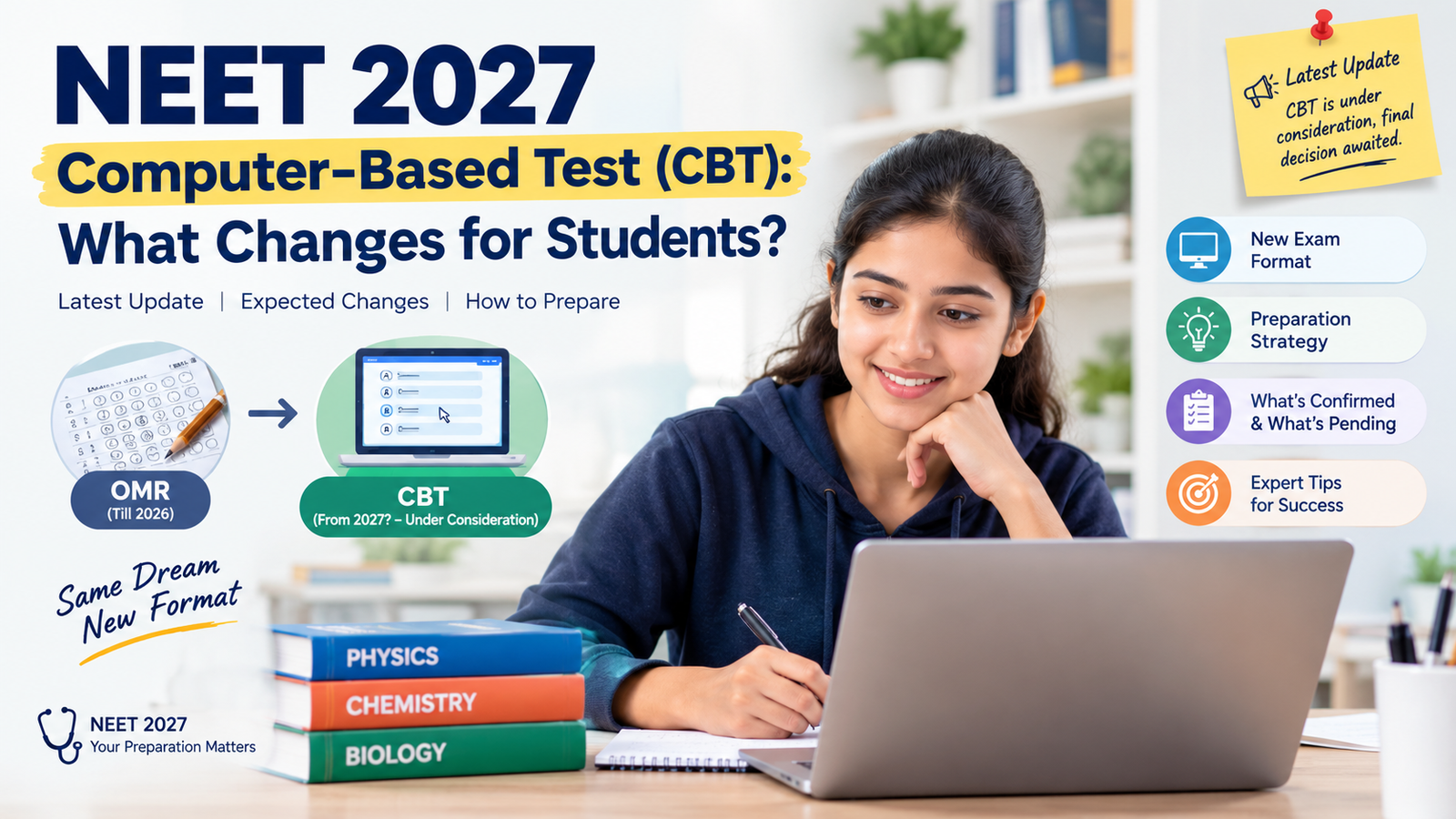
If you’ve just started your NEET 2027 journey, you’re stepping into it at an unusual moment. The NEET 2027 computer based test proposal could change the way students take the examination, as the government is actively considering a shift from the traditional pen-and-paper format to a Computer-Based Test (CBT).
For a first-time aspirant, this can feel overwhelming. You’re already trying to master Physics, Chemistry, and Biology — and now there’s uncertainty about the exam format itself.
For a first-time aspirant, this can feel overwhelming. You’re already trying to master Physics, Chemistry, and Biology — and now there’s uncertainty about the exam format itself.
This guide is built to solve exactly that problem. It covers everything a new NEET aspirant needs in one place: what NEET actually is, the latest CBT update and what it depends on, eligibility rules, the exam pattern, subject-wise weightage, a realistic month-by-month study plan, and the mistakes that trip up most beginners. Bookmark this — you’ll likely come back to it more than once.
Part 1: What Is NEET, and Why Does It Matter?
NEET (National Eligibility cum Entrance Test) is India’s single, unified entrance examination for admission to undergraduate medical courses — MBBS, BDS, and AYUSH courses (BAMS, BHMS, BUMS, etc.) — at government and private colleges across the country. It’s conducted by the National Testing Agency (NTA).
Before NEET was introduced, different states and institutions held their own separate medical entrance exams, which meant students often had to prepare for and appear in multiple exams. NEET replaced that fragmented system with one common test, making it one of the most competitive exams in the country simply because of sheer numbers — lakhs of students compete for a comparatively small number of MBBS seats.
Why it matters for you: Every recognized medical college in India, without exception, admits students only through NEET scores. There is no alternate route into an MBBS seat. This is why NEET preparation is a multi-year commitment for most serious aspirants, not a last-minute effort.
Part 2: NEET 2027 Computer Based Test (CBT) Update — What’s Confirmed?
This is the biggest talking point right now, so let’s be precise about it.
What the Centre Has Actually Said on NEET 2027 computer based test.
The Centre has informed the Supreme Court that the NEET 2027 computer based test proposal is under active consideration. This means the shift from the current pen-and-paper format to a Computer-Based Test (CBT) has not yet been finalized. Students should therefore follow official NTA announcements instead of treating reports or social media updates as confirmed information.
Who Will Actually Decide
The final decision depends on two things:
- Recommendations from a high-level expert task force led by Nandan Nilekani, Infosys co-founder and the architect behind India’s Aadhaar digital identity infrastructure. This task force is reviewing broader reforms to India’s examination systems, including NEET.
- Consultations with stakeholders — likely state governments, medical education regulators, and infrastructure partners needed to support a nationwide digital rollout.
Why This Task Force Matters
Nilekani’s background is significant here. He’s known for building systems that operate at massive scale — hundreds of millions of users — with strong identity verification. A task force under his leadership signals that any CBT rollout for NEET would likely prioritize:
- Robust candidate identity verification
- Secure, leak-resistant question delivery
- Infrastructure capable of serving NEET’s enormous candidate pool across thousands of centres
- Systems designed to directly address the paper-leak and malpractice issues that have plagued NEET in recent years, including the NEET-UG 2024 controversy and a subsequent re-conducted exam in 2026
What This Means for You
Until the task force submits its report and NTA releases an official information bulletin, none of the following should be treated as final:
- Whether NEET 2027 will actually be CBT
- Exam schedule or dates
- Number of sessions or shifts
- Test-centre structure and locations
- CBT interface, navigation, or rough-work arrangements
- Any change to syllabus or marking scheme
Bottom line: CBT is a strong possibility, actively being evaluated at the highest levels — but it is not yet locked in. Treat anything beyond this as speculation unless it comes from an official NTA notice.
For verified updates, always check the official NEET UG website of NTA.
Part 3: NEET Eligibility Criteria (For First-Time Aspirants)
Since this guide is aimed at new aspirants, here’s a quick refresher on who can appear for NEET. (Always verify current-year specifics against the official bulletin once released, as minor rule details can be updated year to year.)
- Educational Qualification: Class 12 (or equivalent) with Physics, Chemistry, Biology/Biotechnology, and English as core subjects from a recognized board.
- Minimum Marks: Generally 50% aggregate in PCB for general category candidates in Class 12; relaxed percentages typically apply for reserved categories.
- Age Criteria: Historically, a minimum age requirement has applied, with upper age limit rules having changed in recent years — always check the latest bulletin, as this is one of the details that has been revised across different NEET cycles.
- Number of Attempts: Currently unrestricted, though this too is periodically reviewed.
- Nationality: Indian citizens, NRIs, OCIs, PIOs, and foreign nationals are eligible, subject to specific seat-category rules.
Because these criteria can shift slightly year to year, first-time aspirants should never rely on last year’s rules — always cross-check with the current NTA bulletin closer to application time.
Part 4: NEET 2027 Computer Based Test — Current Format vs. Possible CBT Format
| Feature | Current (Pen & Paper) | If Shifted to CBT |
|---|---|---|
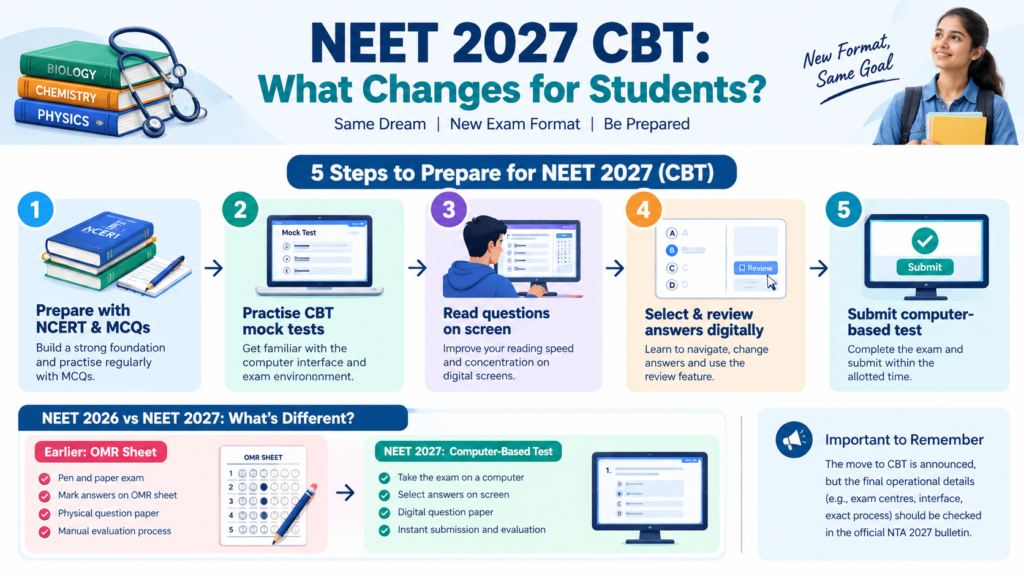
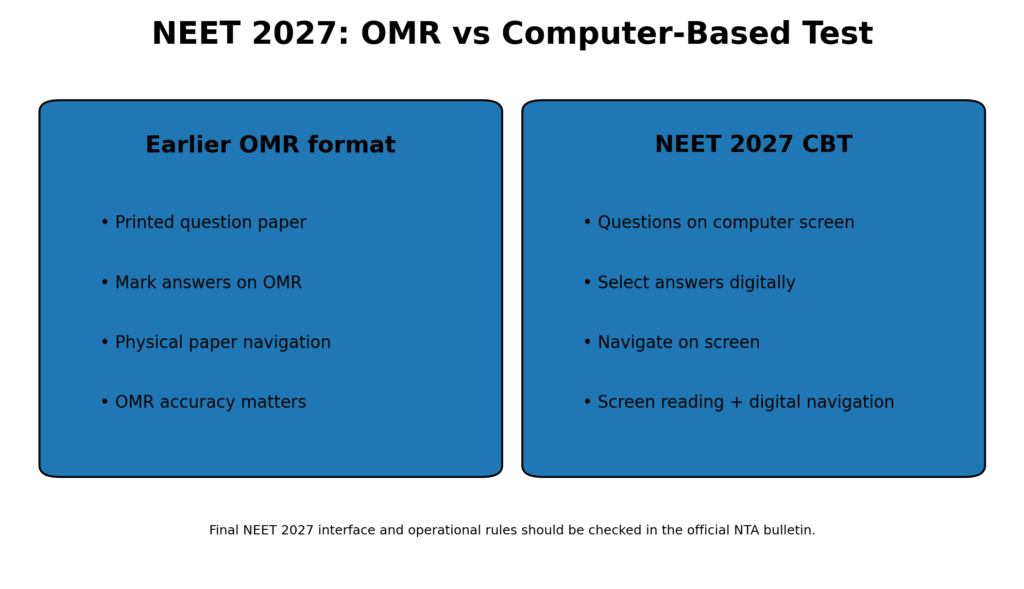
| Exam mode | OMR-based, pen and paper | Computer screen based |
| Answer marking | Bubble on OMR sheet | Click/select on screen |
| Question reading | Printed booklet | Digital display |
| Rough work | Physical paper provided | Arrangement not yet announced |
| Centres | Conventional exam halls | Computer-equipped centres |
| Number of questions | 180 (used for calculation; check current bulletin for exact count) | Expected to remain syllabus-driven, not format-driven |
| Subjects | Physics, Chemistry, Biology (Botany + Zoology) | Unchanged |
| Duration | 3 hours 20 minutes (verify against latest bulletin) | Likely unchanged, pending confirmation |
| Marking scheme | +4 for correct, -1 for incorrect (verify current scheme) | Expected to remain the same unless notified otherwise |
If the NEET 2027 computer based test format is officially introduced, the main change would be the way students interact with the examination. Instead of marking answers on an OMR sheet, candidates would answer questions through a computer interface. However, the exact CBT interface, rough-work rules, centre arrangements and other operational details will depend on the official NTA notification.
Important for new aspirants: A change in exam mode (paper vs. computer) does not automatically mean a change in syllabus, subjects, or marking scheme. These are separate decisions, and none of them are confirmed to change just because CBT is under discussion.
Part 5: Subject-Wise Overview and Weightage
Understanding how marks are typically distributed helps you plan your effort. (Exact weightage can vary slightly year to year — use this as a general guide, not an exact promise.)
Biology (Highest Weightage — roughly 50% of total marks)
Biology typically carries the largest share of marks, split between Botany and Zoology. NCERT is the single most important resource here — the vast majority of questions are drawn directly or closely from NCERT textbook content (Class 11 and 12).
Focus areas: Genetics and evolution, human physiology, plant physiology, ecology, reproduction, and biotechnology.
Chemistry (Balanced across three sections)
Chemistry is usually divided into:
- Physical Chemistry — numerical-heavy, conceptual
- Organic Chemistry — reaction mechanisms, named reactions
- Inorganic Chemistry — largely NCERT-based, factual
Focus areas: Chemical bonding, periodic table trends, organic reaction mechanisms, coordination compounds, and equilibrium.
Physics (Typically the most challenging section)
Physics tends to be numerical and concept-heavy, and many students find it the most time-consuming section relative to marks scored.
Focus areas: Mechanics, electrodynamics, modern physics, optics, and thermodynamics.
New aspirant tip: Don’t spread yourself thin trying to “finish” all three subjects equally in your first months. Biology deserves consistent daily attention since it’s the highest-scoring section and heavily NCERT-based, while Physics and Chemistry need steady, structured problem-solving practice built up over time.
Part 6: A Realistic Month-by-Month Preparation Roadmap
This roadmap assumes you’re starting well ahead of the exam — adjust the pacing based on how much time you actually have left.
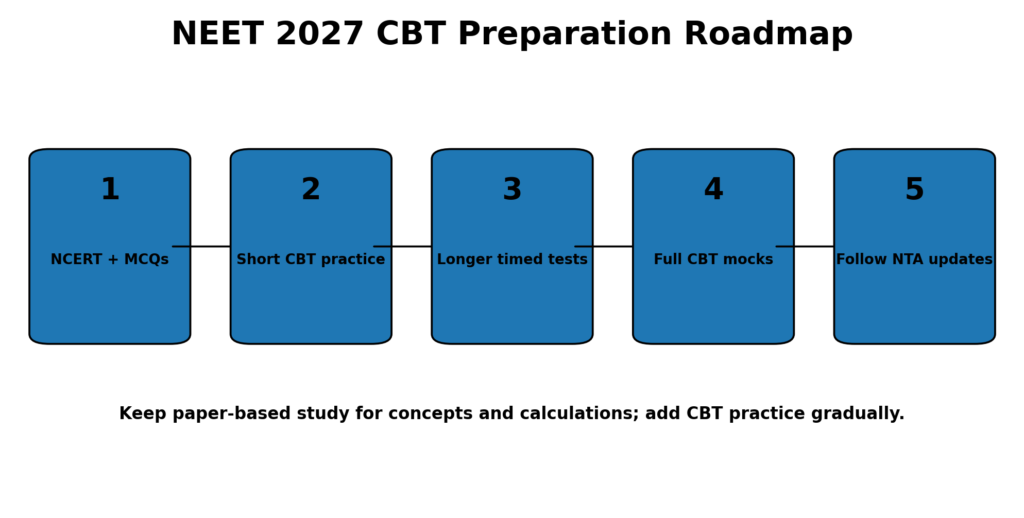
Foundation Phase (First few months)
- Complete NCERT thoroughly for all three subjects — read, don’t skim.
- Build basic concept clarity before moving to advanced problem sets.
- Start a simple daily routine: fixed hours for each subject rather than random studying.
- Begin light exposure to computer-based mock tests occasionally, especially because the NEET 2027 computer based test format is under consideration.
Building Phase (Middle months)
- Move from NCERT to standard reference books and practice question banks.
- Start subject-wise topic tests to identify weak areas early.
- Increase mock test frequency — both paper-based and light CBT practice.
- Begin maintaining an error log: note down every mistake and why it happened (concept gap, careless error, time pressure).
Intensive Practice Phase
- Shift focus to full-length timed mock tests, simulating actual exam duration.
- Increase revision cycles — aim for at least 2-3 full revisions of NCERT before the exam.
- Analyze every mock test in detail: time spent per question, accuracy by topic, and recurring mistakes.
- If CBT is officially confirmed by this stage, increase computer-based mock frequency significantly.
Final Stretch (Last couple of months)
- Stop learning new topics; focus entirely on revision and practice.
- Take full mock tests under real exam conditions (same timing, minimal breaks).
- Revise formula sheets, reaction mechanisms, and NCERT line diagrams repeatedly.
- Work on exam-day logistics: documents required, reporting time, and — if applicable — the CBT interface, once details are officially released.
Part 7: Building the Right Study Habits Early
For a first-time aspirant, habits matter more than intensity in the early months. A few that consistently separate successful aspirants from the rest:
- Daily NCERT reading for Biology, even on light days — consistency compounds over two years.
- Solving MCQs daily, not just reading theory — recognition under exam pressure is a different skill from understanding a concept.
- Keeping an error log — the single highest-leverage habit for improving accuracy over time.
- Timed practice from early on — don’t wait until the final months to introduce a timer; it changes how you think under pressure.
- Regular but not excessive mock tests — one full mock a week in later phases is often more useful than daily fragmented practice.
Part 8: Common Mistakes New NEET Aspirants Should Avoid
- Chasing too many books at once. Depth with fewer, well-chosen resources beats breadth across a dozen references.
- Neglecting NCERT for “advanced” material too early. A large share of NEET questions, especially in Biology, are rooted directly in NCERT.
- Ignoring weak subjects instead of confronting them. Avoidance compounds the problem closer to exam time.
- Treating mock tests as scorekeeping instead of diagnosis. The score matters less than why you lost marks.
- Believing unverified claims about NEET 2027’s format. As covered above, CBT is under consideration, not confirmed — don’t let rumours dictate your preparation strategy.
- Waiting for “the right time” to start CBT familiarity. A little exposure now, even informally, removes friction later if the format does change.
- Burning out through undifferentiated long hours. Structured, focused study consistently outperforms unstructured long sessions.
Part 9: Frequently Asked Questions (FAQs)
Is the NEET 2027 computer based test confirmed?
No. The Centre has told the Supreme Court that a shift to CBT is under active consideration, but the final decision hasn’t been made yet.
Who decides whether NEET 2027 becomes a CBT exam?
The decision depends on recommendations from a high-level expert task force led by Nandan Nilekani, along with consultations with relevant stakeholders.
Will the NEET syllabus change if the exam becomes computer-based?
Not automatically. A change in exam mode doesn’t inherently mean a change in syllabus — these are separate decisions that would each need their own confirmation.
I’m just starting NEET preparation — should I worry about the CBT news?
No. Focus on your core academic preparation first. Add occasional light computer-based mock practice as a low-effort precaution, but don’t let the uncertainty distract you from studying.
Which subject should a beginner prioritize?
Biology is generally the highest-scoring and most NCERT-dependent section, making it a strong daily-priority subject from day one. Physics and Chemistry need steady, structured problem-solving built up over a longer period.
How many hours should a new aspirant study daily?
There’s no universal number — consistency and focus matter more than raw hours. Many successful aspirants build up gradually rather than starting with unsustainable schedules.
Where can I get verified updates about NEET 2027?
Always rely on the official NEET UG website of NTA rather than social media or unverified forwards.
Final Takeaway
The NEET 2027 computer based test proposal is an important development for students, but it is not yet finalized. For a new aspirant, there is no reason to panic. Build your academic foundation in Physics, Chemistry and Biology as usual, while getting occasional exposure to computer-based mock tests.
Most importantly, separate confirmed information from speculation. Follow the official NTA website for the final exam mode, schedule, syllabus, eligibility rules and other NEET 2027 updates.
Two years of consistent, focused preparation will matter far more to your NEET 2027 outcome than the eventual choice between paper and screen.
Sources:
- Times of India – NEET UG 2027 CBT decision not final yet
- Careers360 – NEET UG CBT shift under active consideration
- Official NEET UG website – NTA
Last Updated: September 2026
Note: NEET 2027 exam mode, eligibility rules, exam pattern, and syllabus details should be treated as provisional until officially confirmed by NTA. Always verify against the latest official bulletin.
For more NEET, medical admission, and career guidance, explore the latest guides on AdmissionMantra Blogs.